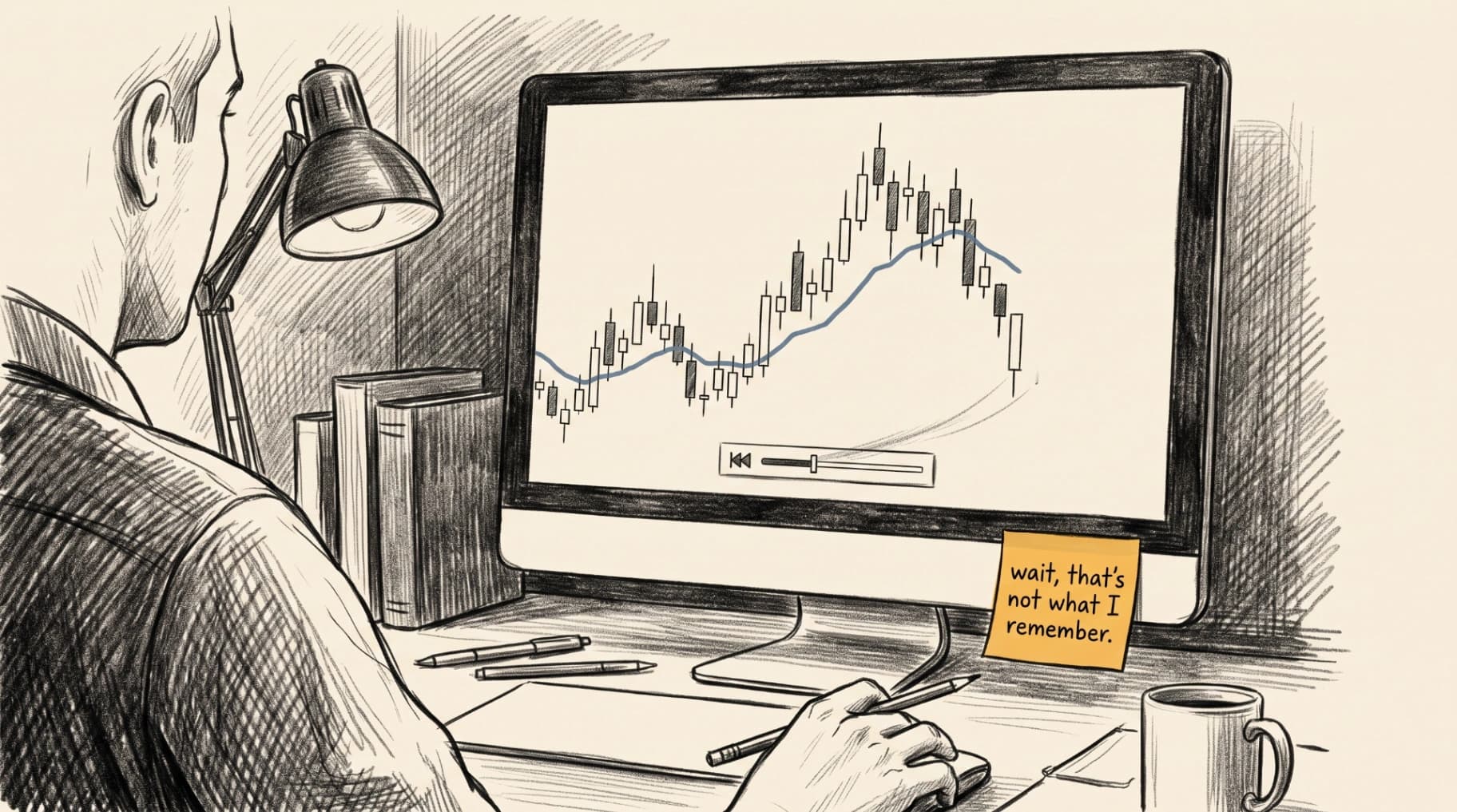
You remember the trade differently than it happened. Not on purpose. This is just how memory works after the fact.
You remember the setup looking cleaner than it did. You remember waiting for confirmation, when the replay would show you clicked in half a second after the candle closed. You remember the exit as a plan, when it was closer to a flinch. By the time you sit down to journal it, your brain has already smoothed the story into something that makes more sense than what actually happened on the chart.
This is the quiet problem with review that relies on memory alone. You are not reviewing the trade. You are reviewing your memory of the trade, and the two are rarely the same thing.
What trade replay actually does
Trade replay takes the price chart from the exact window around your trade and lets you watch it unfold again, candlestick by candlestick, with your entry and exit clearly marked on the timeline. It is not a summary or a screenshot. It is the actual sequence of price action you were trading, rebuilt so you can step back into it.
From there, you control the pace. Play it forward at normal speed to feel the rhythm of how the move developed. Slow it down around your entry to see exactly what the chart looked like in the seconds before you clicked. Pause on the exit to check whether you left because the setup was done, or because the chart flickered red for a moment and your hand moved before your plan did.
You can switch timeframes mid-replay too, dropping from a 15-minute view into a 1-minute view to see the exact candle your entry landed on, then zooming back out to see how that entry fit into the broader move. Overlays like moving averages, RSI, and Bollinger Bands stay active throughout, so you are reviewing the trade with the same context you had, or should have had, when you took it.
Why this matters more than another performance chart
Most analytics tools are good at telling you what happened in aggregate. Replay is different because it shows you what happened in sequence. Those are not the same kind of insight.
A trade analyzer can tell you that your results on breakout setups are weaker than your results on pullback setups. That is useful. But it cannot show you whether you actually waited for the breakout to confirm, or whether you jumped in early on three of those trades because the chart was moving fast and waiting felt unbearable. Replay can. You watch the candle that was supposed to trigger your entry, and you watch where your actual entry marker landed relative to it. Sometimes those two points match. Often, especially on the trades that didn't work, they don't.
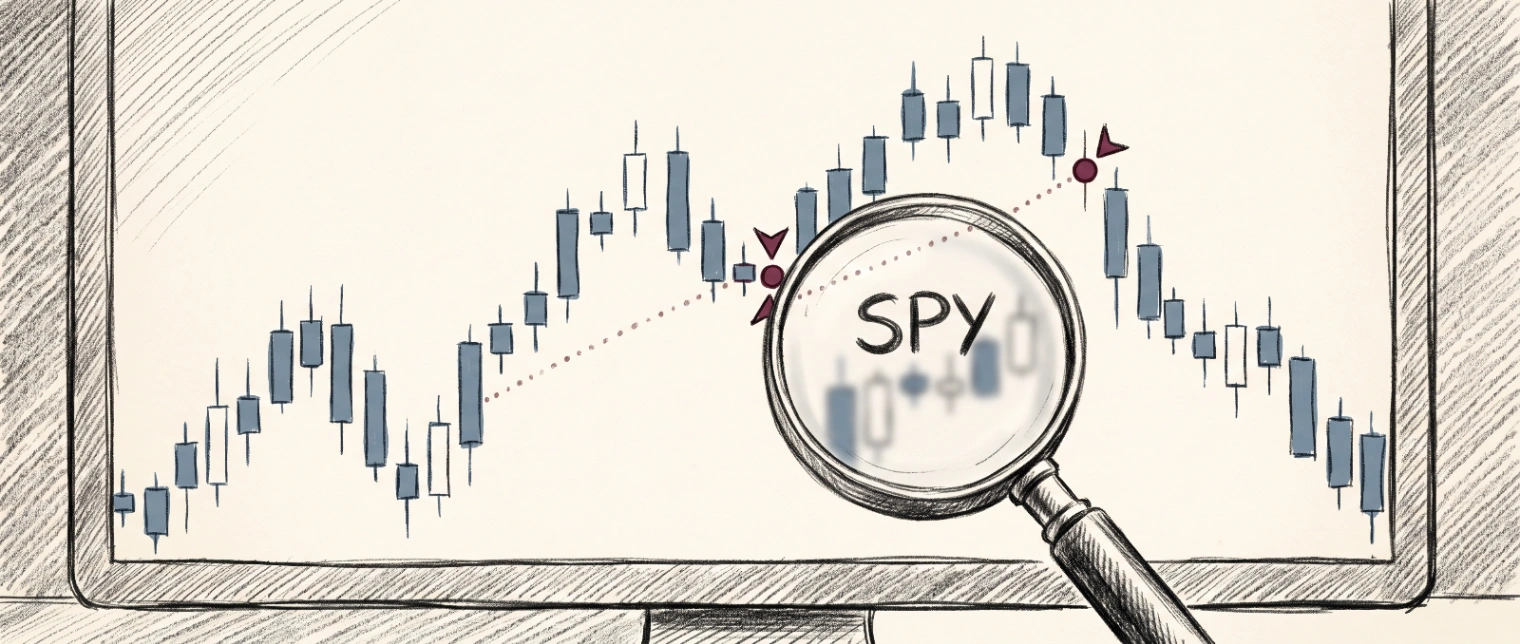
This is also where replay earns its place next to your trading psychology tools. It is one thing to know, in the abstract, that you tend to exit early out of nerves. It is a different thing entirely to watch the replay and see the moment it happened, the candle that spooked you, the seconds where the plan was still valid but you closed the position anyway. That kind of specific, visual evidence is much harder to argue your way around than a note you wrote after the fact.
Where replay fits into your review process
Replay works best as a follow-up step, not a replacement for your existing review habits.
Start with your day trading journal or session notes to flag the trades worth a closer look, the ones that surprised you, confused you, or didn't go the way your plan said they should. Then open replay on those specific trades rather than every trade from the session. Reviewing everything in slow motion is exhausting and dilutes the trades that actually need attention.
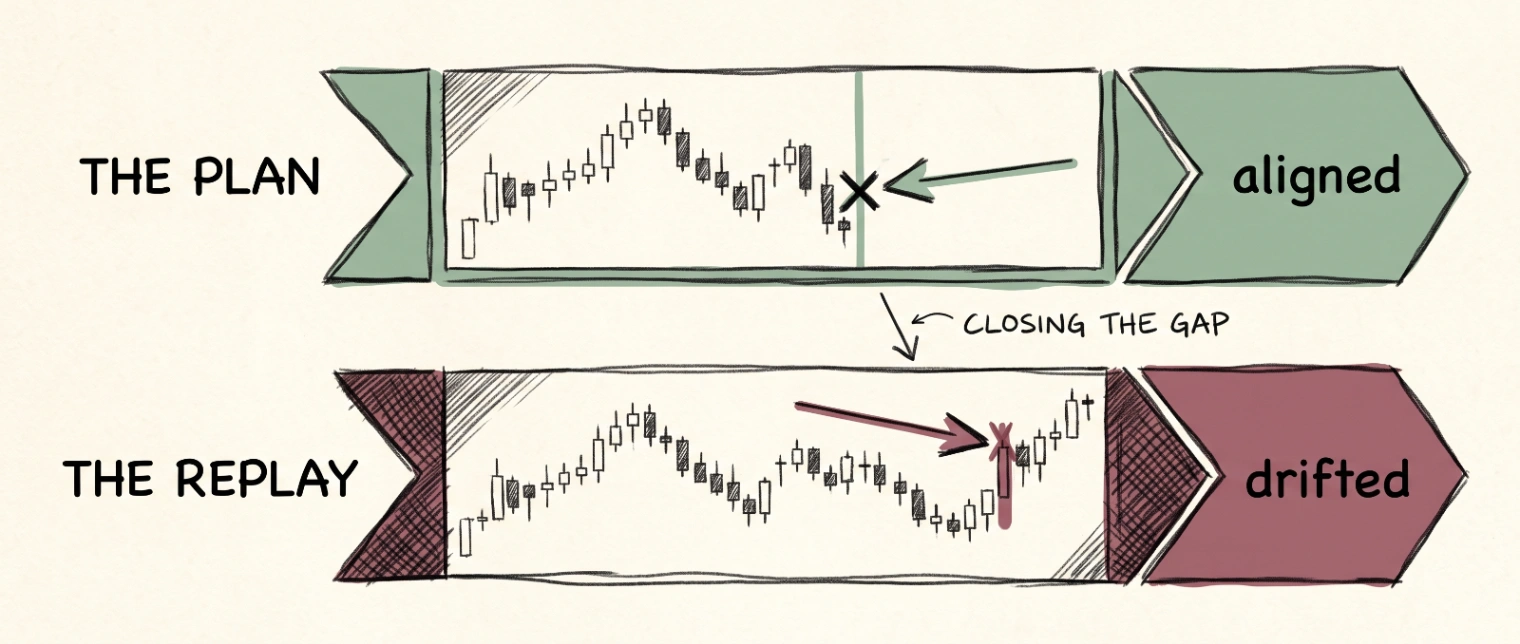
When you do open a replay, look for the gap between your plan and your execution. Did your entry land where your setup said it should, or several candles later? Did your exit come from a rule, or from a reaction? Did the chart actually invalidate your thesis, or did it just move against you briefly before continuing in your favor? These are questions a static list of trades cannot answer, but a few seconds of replay usually can.
Replay also pairs naturally with how you backtest a strategy. Backtesting shows you how a strategy behaves across many historical instances. Replay shows you how you personally behaved inside a specific instance of it. One tells you if the strategy has an edge. The other tells you if you are actually executing that edge, or quietly editing it in the moment under pressure.
The pattern replay is best at catching
There is a specific category of common trading mistakes that almost never shows up clearly until you watch the replay: the gap between the setup you meant to take and the setup you actually took.
Chasing a move that already ran is a good example. In memory, it often gets filed as "I saw the breakout and took it." In replay, you can see that the breakout candle had already closed two bars earlier, and what you actually entered on was the continuation candle, at a meaningfully worse price with meaningfully worse risk. Nothing about that is visible in a trade log showing entry price, exit price, and outcome. It is only visible when you watch the sequence.
The same goes for the setups you almost took and talked yourself out of, and the ones you took without a plan at all because the chart looked exciting. Replay does not judge these moments. It just shows them to you clearly enough that you can decide, on your own terms, whether that is how you want to keep trading.
Building replay into your routine without it becoming a chore
You do not need to replay every trade to get value from this. Pick a small number each week, the ones flagged during pre-trade planning as high conviction, the ones that felt off in the moment, and the ones with results that didn't match how the setup looked on paper. Review those in replay, note what you see, and move on.
Over time, the goal is not to relive every trade in detail forever. It is to close the gap between how you think you trade and how you actually trade, until the two start to match. Once your memory and your replay agree more often than not, you know your process is genuinely tightening up, not just sounding better in the retelling.
FAQ :
What is trade replay in a trading journal?
Trade replay is a feature that reconstructs the price chart around a specific trade and lets you watch it play forward again, with your entry and exit marked, so you can review exactly what the chart was doing rather than relying on memory.
How is trade replay different from a regular trade history log?
A trade history log shows the outcome of a trade in a single row of data. Trade replay shows the sequence of price action leading up to that outcome, which reveals timing, hesitation, and execution details a static log cannot capture.
Can I control the speed of the replay?
Yes. Replay typically includes play, pause, and speed controls, along with the ability to switch between timeframes, so you can move quickly through the parts you already understand and slow down around the moments that matter most.
Does trade replay work with technical indicators?
Yes. Overlays like moving averages, RSI, and Bollinger Bands stay active during replay, so you are reviewing the trade with the same technical context that was available to you at the time.
How often should I use trade replay?
Most traders get the most value from reviewing a small, targeted set of trades each week rather than replaying everything. Focus on the trades that surprised you, felt off in the moment, or produced results that didn't match the setup.
Is trade replay useful for beginners or only experienced traders?
Both. Newer traders benefit from seeing clearly how their entries and exits compare to their intended setups early on, before those habits are fully formed. Experienced traders use it to catch small execution drift that builds up over time.