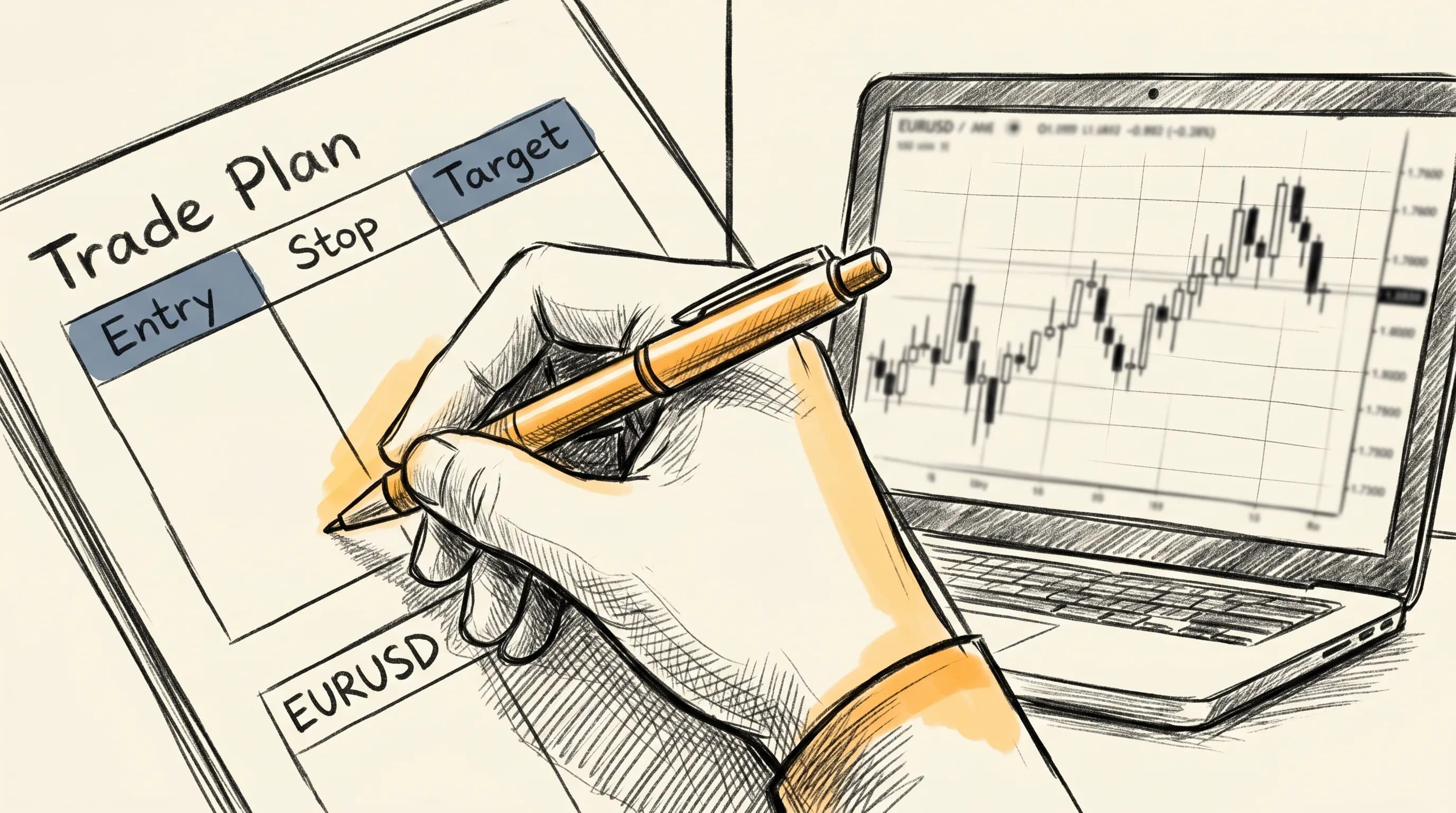
There is a version of this that almost every trader knows. The market opens, something moves, and before any real thinking happens, there is already a position on. No written plan. No defined exit. No sense of what would make the trade wrong. Just an entry, and then hope.
It does not always end badly. Sometimes it works. That is actually part of the problem — because when it works, it reinforces the idea that planning is optional. That instinct is enough. That you can figure it out in real time.
You cannot. Or rather, sometimes you can, but not reliably, and not in a way that compounds into trading consistency over weeks and months. Consistency comes from process, and pre-trade planning is the foundation of that process.
This guide covers what pre-trade planning actually involves, why most traders skip it, and how to build a routine that makes better entries almost automatic.
What Pre-Trade Planning Actually Means
Pre-trade planning is not about predicting what the market will do. It is about deciding in advance what you will do — before emotion, before noise, before the pressure of a moving price cloud your thinking.
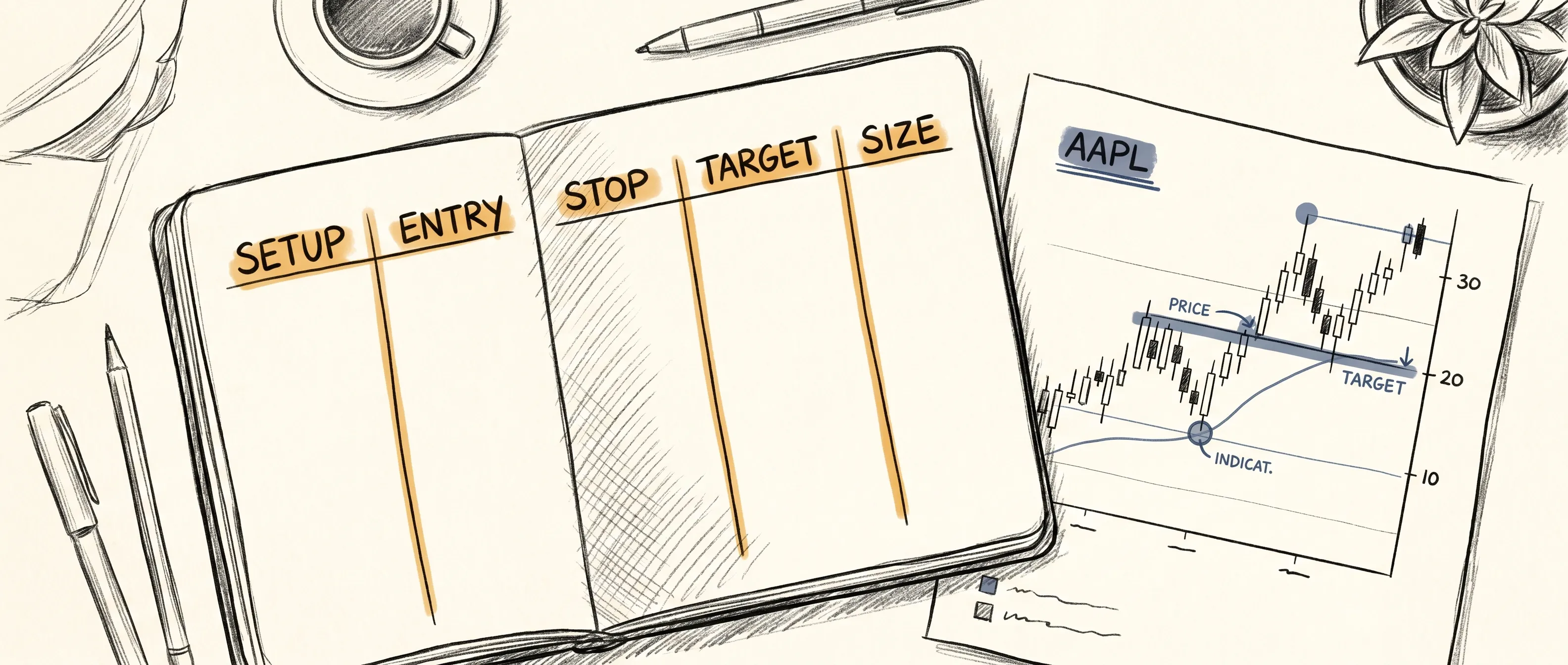
A proper pre-trade plan answers five questions before you open a position:
What is the setup, and does it meet your criteria?
Where is your entry, and what confirms it?
Where is your stop, and why is it there?
What is your target, and what is the risk-to-reward ratio?
How much are you risking, and does that position sizing fit your current account state?
If you cannot answer all five clearly before the trade, you do not have a trade — you have a guess. Guesses can make money in the short term. They do not build an edge.
Why Traders Skip It
The honest answer is that pre-trade planning takes time and creates accountability. Both of those things are uncomfortable.
When you write a plan before a trade, you cannot pretend the entry was obvious after the fact. You cannot revise your stop in hindsight. You have a record of what you intended, and later you have a record of what actually happened. That gap — between intention and execution — is where most of the real learning lives. But it is also where most of the discomfort lives.
Emotional trading thrives in ambiguity. When there is no plan, there is nothing to be wrong about. You can always construct a reason after the fact. Pre-trade planning removes that escape route, which is exactly why it works, and exactly why most traders avoid it.
The other reason traders skip it is speed. Markets move. Opportunities look like they are disappearing. Planning feels like it costs time you do not have. In practice, the opposite is true — traders who plan spend less time in bad trades, recover faster from losses, and spend less mental energy on decisions that have already been made.
The Five Elements of a Solid Pre-Trade Plan
1. Setup Definition
Before anything else, you need to know what you are looking for and why it qualifies. This means having a clearly defined setup — the conditions that need to be present before you will consider an entry.
A setup is not "it looks good." It is specific: the session, the structure, the trigger, the context. EURUSD at the London open after a clean break of prior-session high. AAPL pulling back to the 20 EMA inside an uptrend on above-average volume. Whatever your edge is, it should be describable in a sentence or two. If you cannot describe it, it is not a setup — it is a feeling.
The more specific your setup definition, the more useful your behavioral trading analysis becomes over time, because you can actually track which setups are working and which are not.
2. Entry and Confirmation
The setup tells you what you are watching for. The entry tells you the exact condition that triggers the trade. These are not the same thing.
Many traders see a setup forming and enter early — before confirmation — because they are afraid of missing it. That impatience is one of the most expensive habits in trading. Define the confirmation before the session opens. What needs to happen for you to actually pull the trigger? A candle close above a level? A specific price? A break of a range? Write it down.
3. Stop Placement
A stop is not just where you get out if you are wrong. It is the statement of where your trade idea is invalidated. If price reaches your stop, the setup you planned for is no longer in play. That framing matters — because it means your stop should be placed at the point where the market is telling you the thesis is broken, not at the point where the loss hits a number you are uncomfortable with.
Stops placed around discomfort rather than logic are stops that get moved. And moved stops are how small losses become large ones.
4. Target and Risk-to-Reward
Define your target before you enter. Not vaguely — specifically. The next significant level. The measured move. The prior high. And once you have the target and the stop, calculate the risk-to-reward ratio explicitly.
If the ratio does not meet your minimum threshold, the trade does not qualify — no matter how strong the setup looks. This is one of the hardest rules to follow in real time, which is exactly why it needs to be a rule, not a judgment call made in the heat of the moment.
5. Position Size
Once you know the risk per trade, position sizing becomes straightforward: how much of your account are you willing to lose if the stop is hit? That percentage determines your size. It should not change based on how confident you feel about a particular trade. Confidence is not a reliable signal. Process is.
The Element Most Traders Forget: Mindset
Even a technically perfect plan can be undermined by the mental state of the person executing it.
Pre-trade planning should include a brief check on your own condition before the session opens. Not a lengthy self-assessment — just a few honest questions. Did you sleep? Did anything happen this week that is sitting in the background? Are you coming off a losing streak, or a strong run that has inflated your confidence? How is your focus right now?
This is not soft. It is operational. Trading psychology tools exist precisely because trading performance is not purely technical — it is the product of decision-making under pressure, and the quality of those decisions is directly affected by the state you are in when you make them.
A pre-trade routine that includes a mindset check is one that is more likely to catch the days when you should reduce size, or step back entirely, before the market does it for you.
How to Build a Pre-Trade Routine That Sticks
The goal is not to write a novel before every trade. It is to build a short, consistent sequence that happens before every entry without friction.
Most traders find that 10 to 15 minutes before the session is enough — reviewing the key levels, checking the economic calendar, confirming which setups are in play, and running through the five elements for any trade they are considering.
The critical part is writing it down. Not in your head. On paper, in a notes app, or in your trading journal. The act of writing forces clarity in a way that thinking does not. If you cannot write the plan clearly, you do not have a plan.
Over time, this also builds an extraordinary data set. When you backtest a trading strategy, you are working with historical data. When you pre-plan every trade and review those plans afterward, you are building a live record of your actual decision-making — which setups you planned well, which entries you second-guessed, which targets you cut short. That record, reviewed consistently, is how real improvement happens.
Where an AI Trading Journal Changes the Picture
One of the practical problems with pre-trade planning is that reviewing those plans after the fact is time-consuming. You write a plan, the trade plays out, and then weeks later you have a folder full of notes that you have not actually analysed.
An AI trading journal changes that workflow. Instead of manually comparing planned entries to actual entries across hundreds of trades, you can ask direct questions: where did my execution differ from my plan? Which setups am I following through on, and which ones am I abandoning? Is there a pattern in the trades where I ignored my pre-trade notes?
That kind of analysis is what turns pre-trade planning from a discipline exercise into a genuine feedback loop. The plan is not just good practice — it becomes data. And data, properly interrogated, tells you things about your own trading that no amount of manual review would surface.

The Habit That Compounds
Pre-trade planning is not exciting. It does not give you better setups or smarter entries on its own. What it does is make you accountable to your own process — and that accountability, maintained consistently, is what separates traders who improve from traders who just accumulate experience without changing.
Every professional trader, regardless of style or instrument, has some version of this routine. The form varies. The function does not: know what you are doing and why before you do it.
Start small. Pick one session. Write the plan for one trade. Review it afterward. Do it again. The habit builds faster than you expect, and the clarity it creates — before the trade, not after — is something most traders wish they had started earlier.
FAQ
What is pre-trade planning in trading?
Pre-trade planning is the process of defining every key decision about a trade — setup criteria, entry trigger, stop placement, target, and position size — before the market opens. It removes in-the-moment guesswork and replaces it with a written plan made when your thinking is clearest.
How long should a pre-trade plan take?
For most traders, 10 to 15 minutes before the session is enough. The goal is not length — it is clarity. A plan that takes two minutes and answers all five key questions is better than a lengthy review that still leaves your entry criteria vague.
Does pre-trade planning work for day traders?
Yes. Day traders benefit the most from it, because the speed of intraday trading makes in-the-moment decisions more vulnerable to emotion. Planning which setups you will take and at what levels — before the session opens — means fewer reactive, unplanned entries during the session itself.
What should I include in a pre-trade plan?
At minimum: the setup and why it qualifies, the entry trigger, the stop and why it is placed there, the target, the risk-to-reward ratio, and the position sizing. A brief mindset check is worth adding too — how you are feeling before a session affects how you execute during it.
What is the difference between a trading plan and a pre-trade plan?
A trading plan is the broader document that defines your strategy, rules, and approach to markets. A pre-trade plan is trade-specific — it applies your overall trading plan to a particular setup on a particular day. Both matter, but the pre-trade plan is what connects strategy to execution.
How does journaling support pre-trade planning?
A journal captures both the plan and the outcome — which means you can review where your execution matched your intentions and where it did not. Over time, that comparison surfaces patterns that are impossible to spot in real time: which setups you abandon at the last second, which targets you cut short, which risk rules you bend. An AI trading journal makes that analysis faster by letting you query your own history directly.
Can pre-trade planning reduce emotional trading?
Significantly. Most emotional trading happens when decisions are made without a framework — when you are reacting to price rather than executing a plan. When the plan already exists before the session starts, there is far less room for impulse to take over.