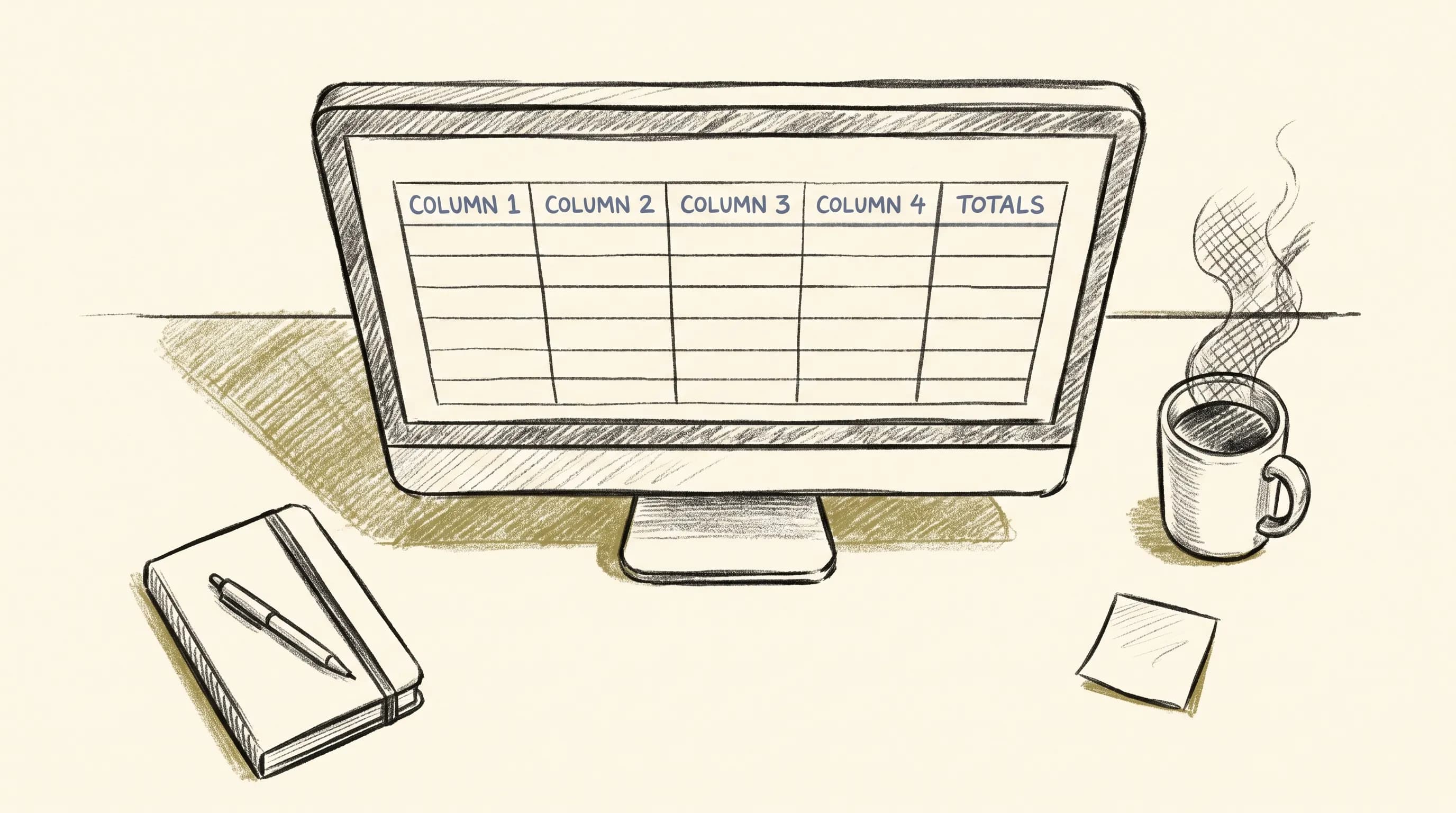
Most traders start the same way. They open Excel, label a few columns — date, ticker, setup, entry, exit, size — and tell themselves: if I track everything properly, the answers will show up.
For a while, it feels like the right move. The spreadsheet looks organised. It feels professional. It feels like discipline.
Then the cracks start showing.
A difficult session ends. The last thing you want to do is fill in rows. You skip it. You log it later. You only log the trades you remember clearly — which usually means the ones that went your way. Quietly, without noticing, your spreadsheet starts becoming a partial record of a selective memory.
This is not a character flaw. It's a design problem. A trading journal spreadsheet is a legitimate starting point — but it is a starting point. Understanding what it does well and where it runs out of road is how you get the most from it, and how you know when you've outgrown it.
What a Trading Journal Spreadsheet Actually Does Well
Before critiquing the format, it's worth being honest about its genuine strengths.
It teaches you what matters. Building a journal from scratch forces you to think carefully about what's worth tracking. That exercise — deciding which variables might explain your decisions — is valuable in itself, regardless of what the data eventually shows.
It gives you full flexibility. You can add any column you want, structure rows however makes sense for your setup, and build formulas tailored to your specific style. No software platform gives you that level of customisation out of the box.
It has zero barrier to entry. For traders in the early stages, a spreadsheet costs nothing and starts immediately. When you're still testing whether you'll commit to journaling at all, that frictionless starting point matters.
It creates a historical record. Even a basic spreadsheet, consistently maintained, builds a dataset with real value — especially if you later move to a more capable tool and want to carry that history with you.
For a trader at the beginning of their journaling practice, a spreadsheet is a reasonable and respectable choice.
Where a Trading Journal Spreadsheet Breaks Down
Here's where the more uncomfortable truths begin.
The manual entry problem. Most traders abandon their spreadsheets within weeks. Not because they lack commitment in general, but because logging trades manually after emotionally draining sessions is genuinely hard. The friction of opening Excel, copying numbers, resizing columns, and sorting rows is not a minor inconvenience. Over time, it competes directly with the mental energy needed for decision-making — and that's the same mental energy that should be going into the next session, not the last one.
The static data problem. A spreadsheet captures what happened. It does not tell you why it happened, when it tends to happen again, or what conditions were present when it did. Every insight you want to extract has to be built from scratch: pivot tables, custom formulas, conditional formatting, filtering logic. Each one takes time that most traders don't allocate — which means the data just sits there.
The context problem. The most important information in any trade is not the entry and exit. It's the context: the emotional state going in, whether the plan was followed, how the setup compared to similar setups under different market conditions. A spreadsheet can hold a text note. But it cannot connect those notes to patterns, surface them when relevant, or flag when a behaviour is repeating.
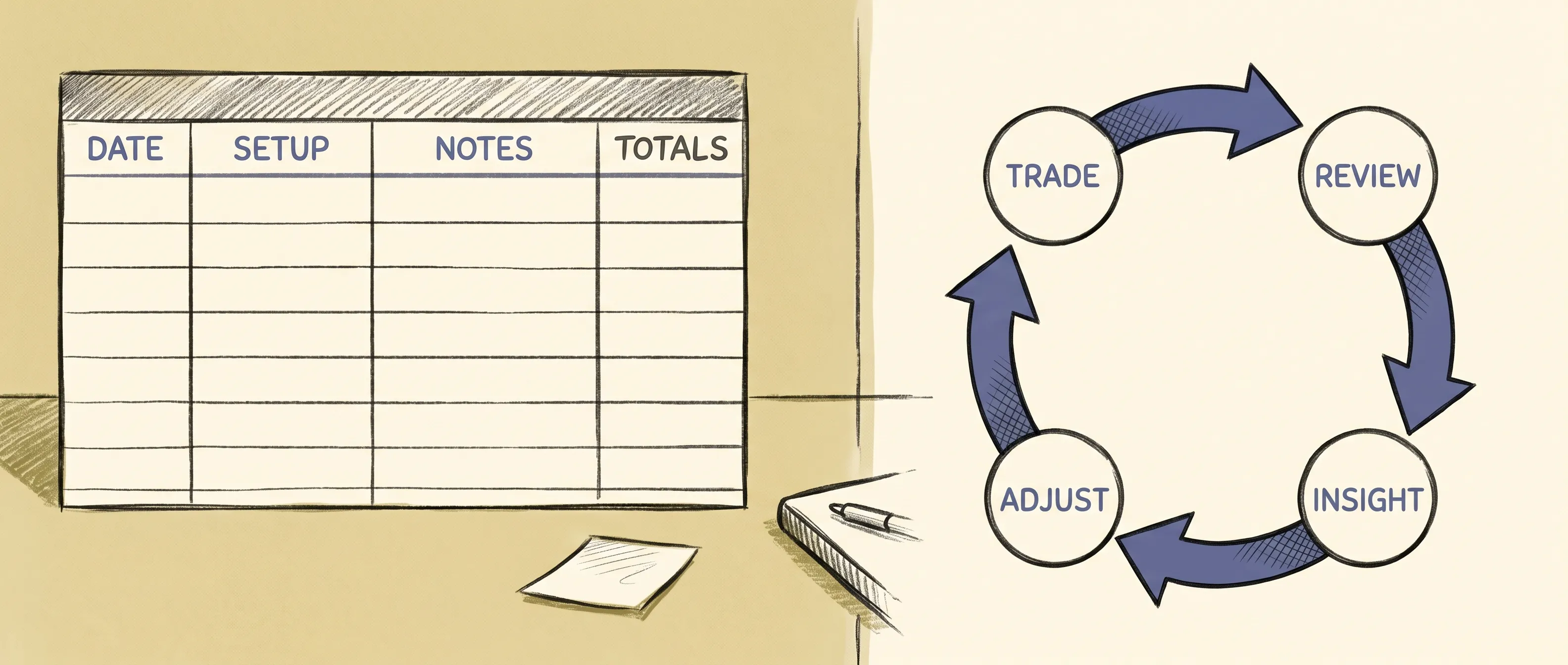
The feedback loop problem. The purpose of a journal isn't to record history — it's to create a feedback loop. A system that turns experience into improvement, consistently, without depending on willpower to run the analysis every weekend. Spreadsheets are structurally weak at this. The data sits in rows. The insights require someone to build the formulas to find them. And even then, what you get is a static snapshot rather than a living analysis.
This is the gap that dedicated trading journal software was built to close.
What to Include in a Trading Journal Spreadsheet
If you're in the early stages and a spreadsheet is where you're starting, here is a practical field structure that gives you the most analytical return over time.
Core fields:
Date and time of entry
Instrument (ticker, pair, or contract)
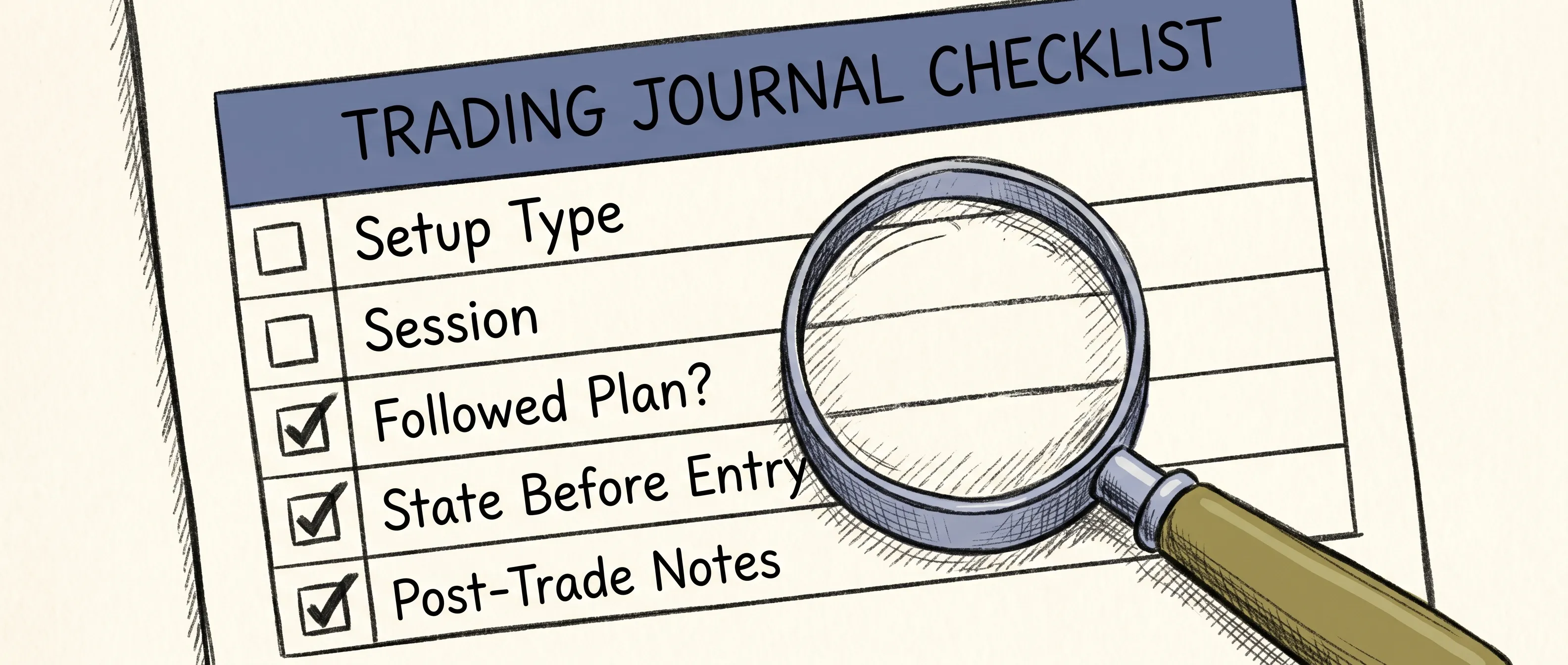
Setup type (your own label — keep it consistent)
Entry and exit price
Position size
Planned risk-reward ratio
Actual result (measured in R-multiples, not currency)
Session (pre-market, open, midday, close)
Followed plan? (Yes / No / Partially)
Behavioural fields:
Pre-trade confidence level (1–5 scale)
Emotional state before entry (one word)
Post-trade reflection (two to three sentences)
The behavioural fields are the ones most traders skip — and the ones that create the most insight over time. Within five minutes of closing a trade, fill them in while the session is still fresh. That habit, sustained over months, builds a behavioural dataset that most traders never construct.
One important principle: consistency beats completeness. A journal with 70% of fields filled on every trade is worth more than a journal with 100% of fields filled on 30% of trades. Choose the fields you'll actually maintain, and maintain them.
Spreadsheet vs. Dedicated Trading Journal
Spreadsheet: Manual build, manual entry every session, static data you have to analyse yourself, text notes only, degrades as volume grows.
Dedicated Journal: Ready from day one, broker-connected auto-import, patterns surfaced automatically, structured behavioural tracking with AI assistance, improves as volume grows.
The difference is not cosmetic. It is the nature of the learning loop itself. A spreadsheet requires you to build the analysis engine. A dedicated journal is the analysis engine.
When It's Time to Move On
There is a specific moment most traders can identify in hindsight — the moment the spreadsheet stopped surprising them. They opened it, reviewed it, and already knew what it would say. The data was there but it had stopped changing anything.
That is the signal.
When a journal no longer changes behaviour, the brain stops investing in it. When the brain stops investing, the entries get shorter, less frequent, and less honest. And when that happens, the journal isn't a tool anymore — it's a habit that feels like work.
The solution isn't more discipline. It's a different kind of tool. One that reduces the friction of logging, increases the quality of the feedback, and makes the analysis you'd otherwise spend hours building available in seconds.
Platforms like ChartWise are designed for exactly this transition. Trades are imported automatically from connected brokers. Patterns are surfaced across hundreds of sessions, not just the last ten. Behavioural tendencies — which conditions correlate with impulsive decisions, which setups are being over-traded, where the plan breaks down — are visible without formulas.
The result is not just more data. It's more usable data. The kind that actually changes what happens in the next session.
For a full breakdown of what the next generation of journaling looks like, see our guide to the AI trading journal and the best trading journal guide for 2026.
The Real Reason Traders Upgrade
Traders who switch from spreadsheets to dedicated tools aren't looking for a shinier interface. They've hit a ceiling — and they know it.
The spreadsheet gave them records. What they need now is feedback. A system that reviews sessions the way a good coach would: identifying patterns, flagging repetitive decisions, tracking whether improvements from one week are holding in the next.
That shift — from records to feedback — is what separates journaling that actually improves performance from journaling that occupies time.
Whether you're exploring a structured day trading journal approach, building out a proper trading performance tracker, or comparing what a full ChartWise trading journal looks like in practice — the direction is the same: less manual overhead, more meaningful insight per session reviewed.
Conclusion
A trading journal spreadsheet is a legitimate place to begin. It builds the habit of recording trades, teaches you what variables matter, and creates a historical dataset that has real value.
But it has a ceiling — and most traders hit it faster than they expect.
The value of any journal lies not in the data it stores but in the feedback loop it creates. When the spreadsheet can't close that loop — when it becomes work without reward — the honest move is to find a tool that can.
ChartWise is built for that next step: a platform that takes raw trading data and turns it into insights a trader can actually learn from, consistently, without the manual overhead.
Join the waitlist and be among the first to use it.
FAQ
1. What should I include in a trading journal spreadsheet?
At minimum: date, instrument, setup type, entry and exit prices, position size, planned risk-reward ratio, whether the plan was followed, and a short post-trade reflection. Behavioural fields — emotional state, confidence level — are often more revealing than numeric data over time.
2. Is Excel good enough for a trading journal?
Excel is a solid starting point. It teaches you what to track, offers complete flexibility, and costs nothing. The limitation is structural: manual entry creates friction, and static rows don't surface patterns or generate a feedback loop the way dedicated software does.
3. How do I make my trading journal spreadsheet more useful?
Prioritise consistency over completeness. Fill in behavioural fields within five minutes of closing each trade, while the context is still fresh. Review weekly rather than daily. Track setup type consistently and note which setups your analysis time is actually improving — that's where the compounding happens.
4. When should I upgrade from a spreadsheet to dedicated software?
When the spreadsheet stops changing your behaviour. If you review it and already know what it will say — if the data is there but not driving improvement — you've outgrown the tool. That's the signal to look at purpose-built alternatives.
5. Can I import spreadsheet data into ChartWise?
Yes. ChartWise supports data import alongside direct broker connections, so your historical trading record doesn't have to be left behind when you make the transition.
6. What makes a dedicated trading journal better than a spreadsheet?
The core difference is the feedback loop. Dedicated journals import trades automatically, surface patterns without manual formulas, and structure behavioural tracking in a way that scales. The analysis that takes hours in a spreadsheet is available at a glance — which means traders actually use it, consistently.
7. Is a free trading journal spreadsheet enough for a beginner?
For the first weeks of journaling, yes. The discipline of manual logging has genuine value early in the learning process. As your trade volume grows and your analysis needs deepen, the friction starts to outweigh the flexibility — and that's when a purpose-built tool starts to justify itself.