The Confidence That Evaporated Overnight
A run of clean, well-executed trades built something that felt solid, a kind of quiet certainty about reading the market that had not been there a few weeks earlier. Then one rough stretch came through, unremarkable by any objective measure, and that certainty did not just dip. It disappeared almost entirely, replaced by second-guessing on setups that would have been taken without hesitation just days before.
This is the tell that the confidence being built was never actually stable to begin with. It was borrowed from recent results, and borrowed confidence gets returned the moment results stop cooperating. What replaces it usually is not caution exactly, it is something closer to a break in trust with a process that had not actually changed at all.
Why Confidence Tied to Outcomes Always Breaks
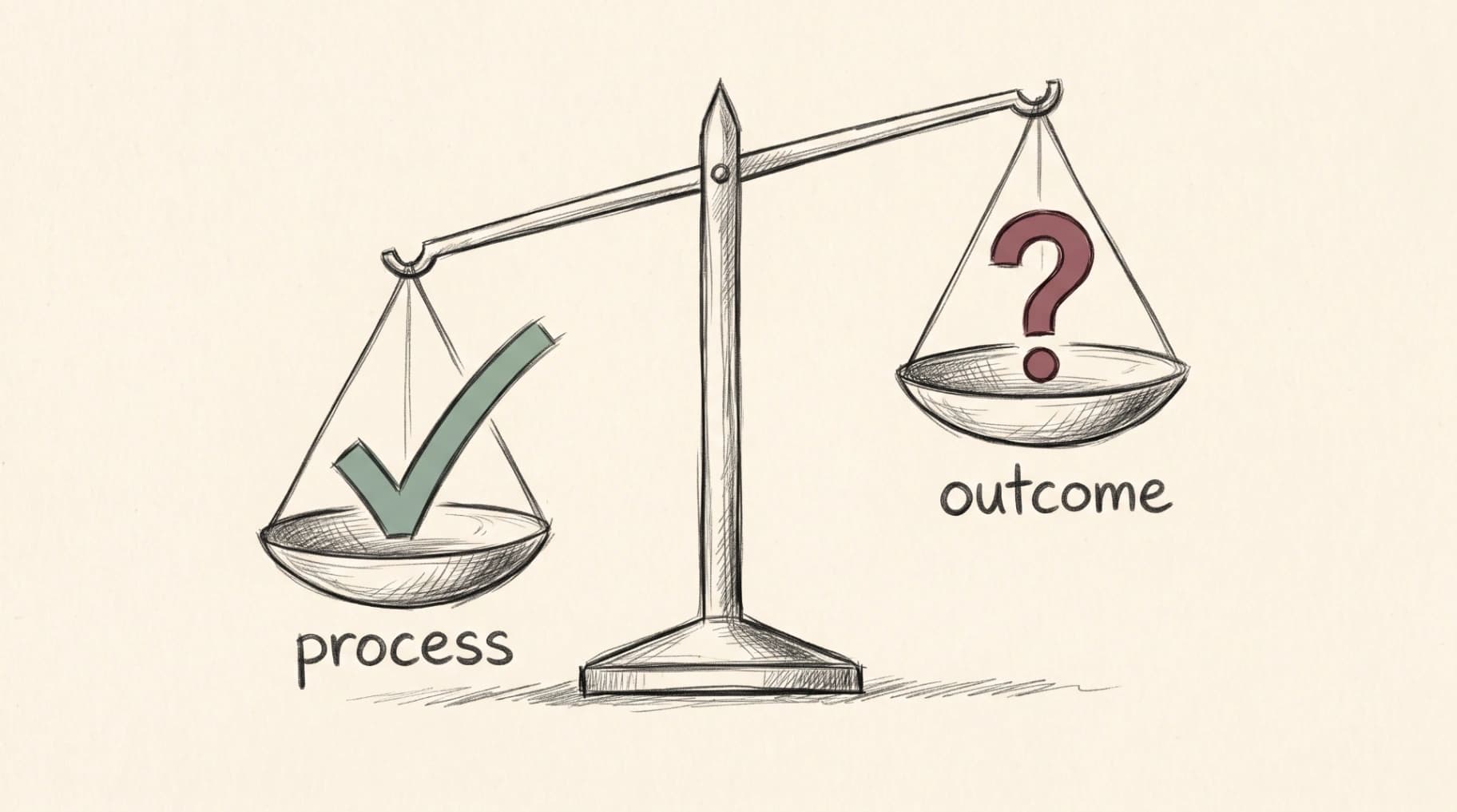
Outcomes are the most available evidence a trader has, so it makes sense that confidence tends to track them by default. The problem is that individual outcomes are heavily influenced by variance that has nothing to do with the quality of the decision that produced them. A well-reasoned entry can still not work out, and a poorly-reasoned one can still work out, often enough that outcome alone is a genuinely unreliable narrator.
Confidence built on outcomes is, structurally, confidence built on noise. It will feel solid during a good stretch and collapse during a bad one, regardless of whether decision quality actually changed in between. This is why the feeling of certainty during a winning stretch and the feeling of doubt during a rough one are both, in a sense, equally unreliable signals about whether the underlying process is actually sound.
What Actually Holds
The alternative is confidence built on process, on whether a decision matched the written plan given the information available at the time, independent of how that specific trade happened to resolve. This kind of confidence is slower to build and far less exciting than a hot streak, but it does not evaporate the moment variance turns unfavorable, because it was never resting on variance in the first place.
A trader whose confidence is process-based can look at a losing trade that was executed exactly according to plan and feel genuinely fine about it, not through forced positivity, but because the actual thing being evaluated, the decision, held up. That is a fundamentally different experience from a trader whose confidence is outcome-based watching the same trade and reading it as evidence that something is wrong.
The Trap of Waiting to Feel Ready
There is a specific way this shows up that is worth naming directly: waiting to feel confident before taking a setup that meets every written criterion. This sounds reasonable, almost responsible, but it quietly inverts the relationship between confidence and competence. Confidence, done this way, becomes a gatekeeper standing in front of good decisions rather than a byproduct of consistently making them.

This overlaps closely with self sabotage trading, where a clean setup gets avoided or delayed for reasons that sound sensible in the moment. Waiting to feel ready is one of the most common disguises that avoidance wears, because it frames inaction as prudence rather than what it usually actually is.
Building It From the Ground Up
Process-based confidence gets built the unglamorous way, through a written plan that gets followed closely enough, often enough, that the connection between following it and feeling steady becomes obvious over time rather than assumed in advance. This is not a mindset shift that happens in a single session. It accumulates the same way any skill does, through repetition that gets tracked rather than just lived through and half-remembered.
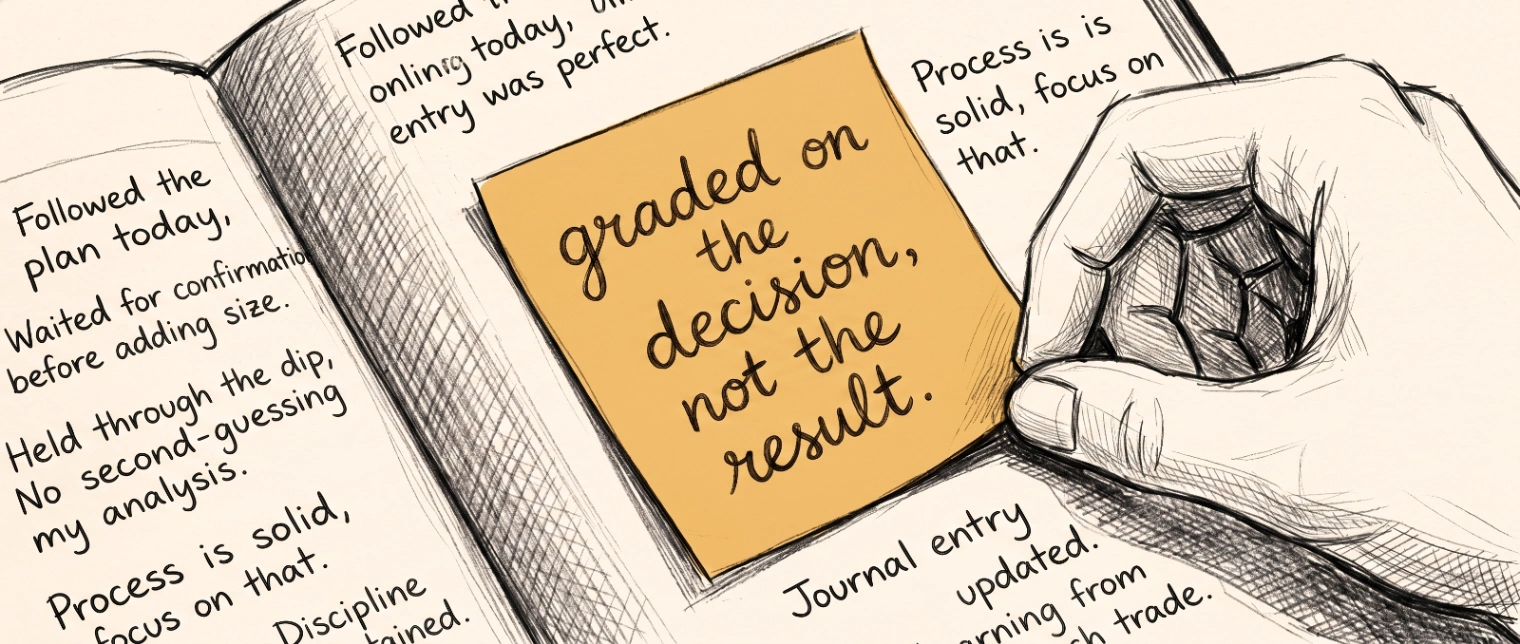
A structured log, the kind trading psychology tools are built around, is what makes this trackable rather than just a vague sense of improvement. Grading each entry against the plan that was in place at the time, separate from how the trade eventually resolved, is what turns confidence from a feeling that rises and falls with recent results into something closer to an accurate reading of an actual track record.
Why This Compounds Over Time
The traders whose confidence holds up through a rough stretch are not the ones who feel less doubt in the moment. They are the ones who have a specific, evidence-backed answer to that doubt: a log of decisions that matched the plan regardless of how any single trade turned out. That answer does not exist for someone whose confidence was built on a streak, because a streak, by definition, has nothing to point back to once it ends, and it is exactly this steady, repeatable pattern that underlies real trading consistency rather than a run of good weeks.
Building this kind of trading discipline into a fixed trader daily routine, reviewed on a schedule rather than only after a rough stretch prompts a search for reassurance, is what eventually makes the whole question of confidence feel less urgent. Not because doubt disappears, but because there is finally something solid underneath it to check against.
FAQ
Why does confidence built on winning streaks eventually break down?
Because individual outcomes are heavily influenced by variance that has little to do with decision quality. Confidence tracking outcomes directly will rise during good stretches and collapse during bad ones, regardless of whether the underlying process actually changed.
What does process-based confidence actually look like?
It means evaluating a trade by whether the decision matched the written plan given the information available at the time, rather than by how the trade eventually resolved. A well-executed trade that did not work out can still be graded as a good decision under this approach.
Why is waiting to feel confident before acting a problem?
Because it inverts the relationship between confidence and competence, turning confidence into a gatekeeper in front of good decisions instead of a byproduct of consistently making them. It often functions as a disguised form of avoidance rather than genuine caution.
How can process-based confidence actually be built?
Through a structured log that grades each trade against the plan that was in place at the time, separate from the eventual outcome, reviewed on a fixed schedule. Over enough repetitions, this turns confidence into something closer to an accurate track record rather than a feeling tied to recent results.
Is this related to self-sabotage in trading?
Yes, closely. Waiting to feel ready before taking a setup that already meets every written criterion is one of the more common ways avoidance disguises itself as prudence, which overlaps directly with broader self-