Most traders are not lacking knowledge. They have a strategy. They have a plan. And yet, in the heat of the moment, the plan disappears. A setup that does not quite meet the criteria gets taken anyway. A stop gets moved. A position gets held longer than it should. This is a trading discipline problem, and it is far more common than most traders admit.
Trading discipline is not a personality trait. It is a skill that can be built, measured, and strengthened over time. But to build it, you first have to understand where and why it breaks down.
What Trading Discipline Actually Means
Discipline in trading is simple in theory: you have rules, and you follow them. Entry criteria, exit conditions, position size limits, daily loss caps. Those rules exist because you designed them when you were thinking clearly, not in the middle of a live position with money on the line.
But executing those rules under real market conditions is another matter entirely. Market movement creates urgency. Fear and greed create noise. FOMO pulls you toward trades that do not fit your criteria. Overconfidence after a strong session pushes you toward larger size than your plan allows.
Each of these is a discipline failure. And each one has a pattern behind it.
That is the key point. Discipline does not break down randomly. It breaks down for predictable reasons. And if the reasons are predictable, they can be tracked, analyzed, and addressed.
The Most Common Trading Discipline Failures
Understanding your personal breakdown points is step one. Here are the patterns that appear most consistently across traders at every experience level.
Entering off-plan. The setup does not meet your criteria, but you take it anyway. This typically happens after a period of inactivity, when the pressure of waiting becomes uncomfortable and any movement starts to look like an opportunity.
Moving stops. You placed a stop at a logical level before the trade, but when the trade moves against you, the stop gets moved wider rather than accepting the loss. This single habit is responsible for more outsized losses than almost any other behavior.
Overtrading. After a loss, or sometimes after a win, trade frequency climbs beyond what the strategy calls for. Overtrading is rarely a strategy decision. It is almost always an emotional one.
Revenge trading. A loss triggers the impulse to immediately recover it through the next trade. Revenge trading skips analysis, skips setup criteria, and typically produces the second bad trade of the session before the first one has even been processed.
Ignoring the daily loss limit. The rule existed. You had a defined point at which you would stop for the session. But the next trade felt like the one that would turn things around, and the limit got overridden.
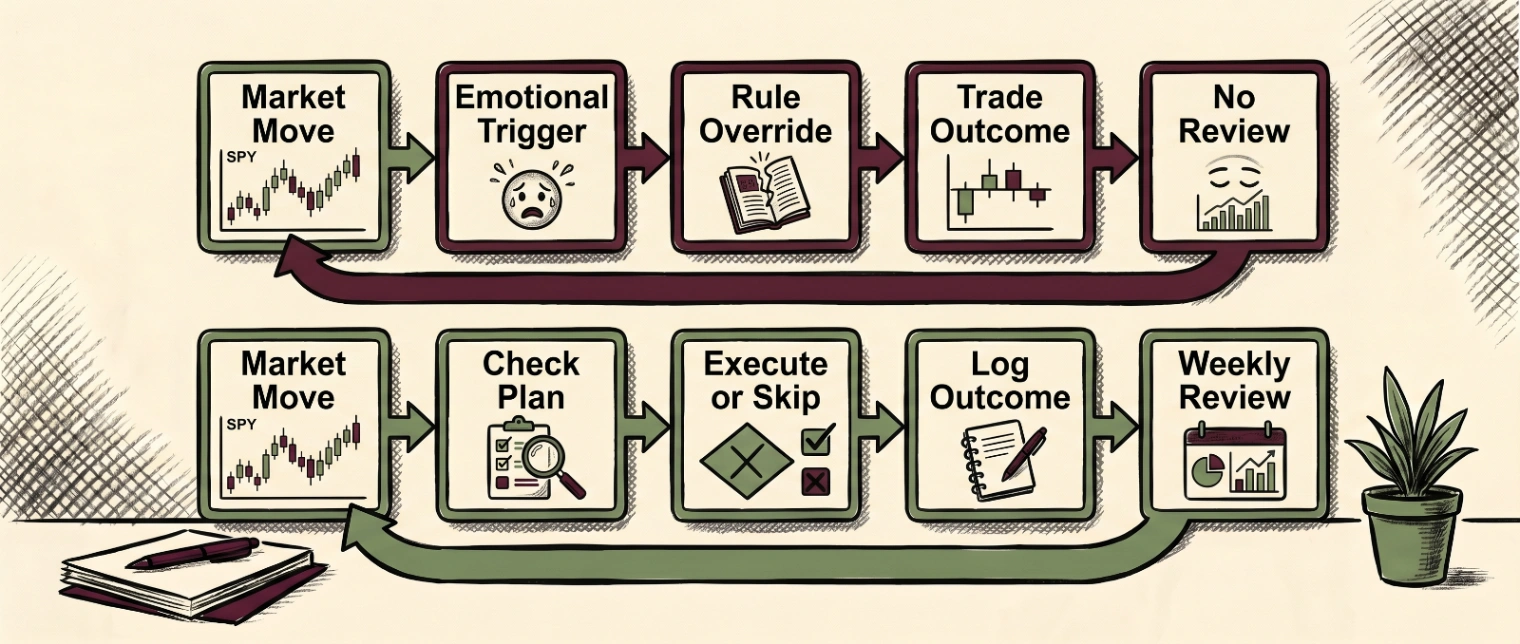
Each of these failures shares one characteristic: the rule existed before the trade, and it was overridden during the trade. The problem is never the rule itself. The problem is the distance between the rule on paper and the behavior in the moment.
Why Discipline Breaks Down
Trading psychology tools and behavioral research both point to the same set of root causes: emotional activation, cognitive bias, and a lack of structured accountability.
Emotional activation is what happens when market movement triggers a physical stress response. When a position moves against you, the brain shifts into a threat-response mode. In that state, rational rule-following becomes harder because the brain is optimizing for threat reduction rather than systematic decision-making. Understanding this is the foundation of real emotional trading solutions. The goal is not to eliminate emotion. It is to build structures that work alongside it.
Cognitive biases layer on top of emotional activation. Recency bias makes the last few trades feel more predictive than they actually are. Confirmation bias makes you see the entry you want to see rather than the entry your system requires. Loss aversion makes cutting a small loss feel disproportionately painful compared to the logical case for exiting. These are not personal flaws. They are documented features of how human decision-making works. Knowing they exist is the starting point for working around them.
Accountability gaps are the third piece. When nothing is being tracked and no one is reviewing the decisions, it becomes easier to override the plan without fully registering what you are doing. The absence of a structured trade review process means those overrides do not get examined. Which means the pattern repeats.
The Role of Journaling and Pre-Trade Planning
Two practices are consistently associated with stronger trading discipline: pre-trade planning and post-trade journaling.
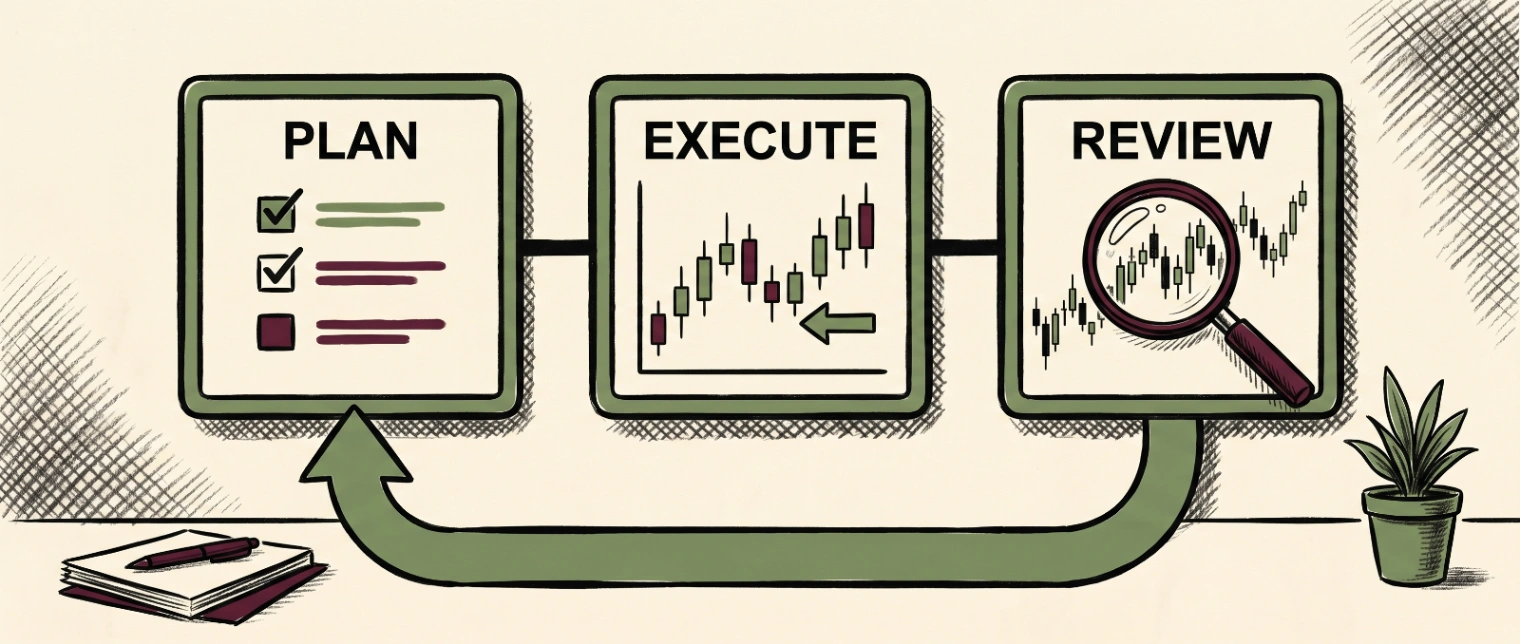
Pre-trade planning forces you to define the trade before it is live. What is the entry condition? Where is the stop? What is the target? What market behavior would invalidate this setup entirely? When those questions are answered in advance, the entry decision carries lower emotional stakes. You are not deciding in real-time. You are executing a decision you already made with a clear head.
Journaling closes the loop. After the trade, you return to the plan you made and compare it to what you actually did. Was the entry on-plan? Was the exit on-plan? Where did the deviation happen, and what was happening in your thinking at that moment? This kind of structured reflection builds self-awareness over time, and self-awareness is the foundation of trading consistency.
The traders who build the strongest discipline are typically the ones who review their trades most rigorously. Not because review is easy, but because it converts vague behavioral patterns into visible data.
How Behavioral Analytics Changes the Picture
Journaling gives you raw material. Behavioral trading analysis converts that raw material into insight you can actually act on.
When your trades are tracked over time, patterns emerge that individual review cannot reveal. Maybe your discipline breaks down specifically on high-volatility days. Maybe your off-plan entries cluster around a particular time of day, or in the third session of the week. Maybe your stop-moving behavior is concentrated in one asset class and completely absent in another. These are not visible in individual trade review. They only appear in aggregate.
This is where a trading performance tracker becomes more than a logbook. It becomes a diagnostic tool.
ChartWise is built for exactly this kind of analysis. The behavioral bias detection feature identifies patterns like the disposition effect (holding losers too long while cutting winners short), overtrading clusters, and off-plan entry frequency across different market conditions. The AI trading journal auto-tags entries, surfaces patterns from your trade history, and can answer specific questions about where and when your discipline is weakest.
The result is not just a better record of what happened. It is a structured picture of why it happened and where to direct your attention.
A Framework for Building Discipline Over Time
Discipline is not something you either have or do not have. It is something you practice, with feedback loops built in. Here is a framework that works.
Define your rules with specificity. Vague rules are easy to override because they leave room for interpretation. "Only enter clean setups" is not a rule. "Only enter when price closes above the 20-period moving average on a 15-minute chart with volume above the 20-period average" is a rule. Specificity removes the wiggle room that lets rationalizations creep in.
Log every trade, including the off-plan ones. Off-plan trades are not failures to hide. They are the most important data in your journal. They are where the patterns live.
Review weekly, not just daily. Daily review shows you what happened today. Weekly review starts to reveal patterns across sessions. Monthly review shows behavioral trends that are too slow to appear in a week.
Focus each review on one specific question. Not "how do I improve everything" but "what was my single biggest discipline failure this week?" One question, one answer, one thing to work on. Behavioral change happens incrementally and specifically. Trying to fix everything at once is itself a discipline failure.
Use your data actively. A journal you write but never analyze is a diary, not a performance tool. Platforms like ChartWise are designed to surface the behavioral patterns you cannot see yourself, turning what would otherwise be invisible habits into something you can name, measure, and systematically address.
The gap between knowing your rules and following them is not closed through willpower alone. It is closed through structure, accountability, and the kind of clear-eyed pattern recognition that only consistent tracking makes possible.
FAQ
What is trading discipline and why does it matter?
Trading discipline is the ability to follow your predefined trading rules consistently, even under the emotional pressure of live market conditions. It matters because most trading plans are sound in theory. The failure point is typically execution. Without discipline, even a strong strategy produces inconsistent results because decisions get made in the moment rather than according to the plan.
Why do traders struggle to follow their own rules?
Discipline breaks down primarily because of emotional activation, cognitive biases, and accountability gaps. When a position is live and moving, the brain responds to perceived threat and opportunity in ways that compete with rational rule-following. Biases like recency bias, confirmation bias, and loss aversion compound this. Without a structured review process to surface the pattern, these failures repeat without being fully recognized.
What are the most common signs of poor trading discipline?
The clearest signs include taking setups that do not meet entry criteria, moving stop-loss levels after entry, overtrading after a loss or a win, engaging in revenge trading to recover a loss, and ignoring predefined daily drawdown limits. These are all patterns that can be identified and tracked through a structured trading journal.
How does journaling improve trading discipline?
Journaling creates a record that makes deviations from the plan visible. When you compare what you planned to do with what you actually did, patterns emerge. Over time, this reflection builds self-awareness about your specific breakdown points, which is the foundation of lasting discipline. The review step is as important as the logging step.
What is behavioral trading analysis and how does it help?
Behavioral trading analysis uses aggregated trade data to identify patterns in decision-making behavior over time. Rather than reviewing trades individually, behavioral analysis looks at clusters, for example whether off-plan entries concentrate around specific times of day, volatility conditions, or asset classes. This aggregate view reveals patterns that individual review cannot surface.
Can ChartWise help me build better trading discipline?
Yes. ChartWise tracks trades alongside journal entries and applies behavioral analysis to identify specific patterns in your decision-making. Features like behavioral bias detection and the AI trading journal surface where and when your discipline is breaking down, so you can address the actual cause rather than treating every session as a fresh start.
What is the difference between trading discipline and trading psychology?
Trading psychology is the broader field covering emotions, cognitive biases, and mindset in trading. Trading discipline is the practical output of applied trading psychology: the consistent execution of your rules in live conditions. Improving trading psychology creates the mental foundation. Trading discipline is what that foundation produces when combined with structure, review, and accountability.