
You can spend an hour finding a clean setup, mark every level properly, wait patiently for confirmation, and still end up with a bad trade for one simple reason: your size was wrong.
That happens more often than most traders admit. Not because they do not understand the market, but because they treat risk like an afterthought. They focus on entry first, then try to figure out how much to buy or sell somewhere in the middle. And that is usually where discipline starts slipping.
A position size calculator fixes that faster than most people expect. In a few seconds, it shows you exactly how much to risk on a trade so you are not guessing, oversizing, or letting emotions decide for you.
The real problem is not always the setup
A lot of traders think their biggest issue is strategy. They keep switching indicators, testing new entries, watching more videos, and hunting for better confirmation. But many of them are not actually losing because the setup is bad. They are losing because the trade size does not match the risk .
This is where things quietly go wrong.
A trader sees a setup that looks strong and sizes up because it feels like a high-conviction trade. Another trader gets nervous after a losing streak and sizes down so much that even a good win barely matters. Over time, there is no consistency. The results become emotional, not structured.
That is why a position size calculator matters so much. It takes one of the most important parts of trading and removes the guessing. Instead of asking, “How much should I put into this trade?” at the last moment, you already know the answer before the order is placed.
What position sizing actually means
Position sizing is simply deciding how large your trade should be based on how much you are willing to lose if the trade fails.
That is it.
It is not complicated when you strip away the jargon. You are not trying to predict the market with it. You are trying to control your downside before the market does anything.
Let’s say your account is $10,000 and you only want to risk 1 percent on a trade. That means your maximum loss is $100. If your stop-loss is far away, your trade size needs to be smaller. If your stop-loss is tighter, your trade size can be larger. The risk stays the same. Only the size changes.
That is the whole point of smart trade sizing.
Without that structure, traders often do the opposite. They choose the size first and only later realize the risk is too big. That is how small mistakes turn into account damage.
Where risk-reward ratio trading fits in
A lot of people confuse trade size with reward potential, but they are not the same thing.
Risk-reward ratio trading is about comparing what you stand to lose with what you stand to make. For example, if you are risking $100 to make $300, that is a 1:3 risk-reward ratio.
Your position size decides how much exposure you take. Your risk-reward ratio helps you judge whether the trade is worth taking.
You need both.
A trade can have a beautiful 1:4 setup on paper, but if you size it carelessly, the risk can still be too high. On the other hand, you can calculate size perfectly, but if the reward does not justify the risk, the trade may still not be worth it.
This is why disciplined traders do not separate these two ideas. They look at the setup, define the stop, check the potential reward, and then use a trading risk calculator to size the trade properly. That process brings clarity. And clarity reduces emotional mistakes.

Why traders struggle with this in real time
In theory, everyone agrees with risk management.
In real trading, people rush.
The market is moving. Candles are closing. Momentum looks strong. You feel like if you do not enter now, you will miss it. In that moment, very few traders want to pause and do math. So they estimate. They round things off. They tell themselves they will manage it manually.
That is where discipline starts breaking down.
The problem is not laziness. It is pressure. Under pressure, people simplify the wrong things. They skip the very step that protects them. Then later, after the loss, they say the market was unfair, or the setup looked valid, or volatility was strange that day.
Sometimes all of that may be true. But often the bigger issue is that the trade was oversized from the beginning.
A position size calculator helps because it makes good risk habits fast enough to use in real conditions. That is what traders need. Not more theory. A process they can actually follow while the market is live
Where ChartWise fits into the process
Knowing how to size a trade is one thing. Doing it consistently, trade after trade, is where most people slip.
That is usually not because traders do not care about risk. It is because live trading moves fast. One moment you are looking at a clean setup, and the next you are already in the trade without properly checking size, stop distance, or how the risk fits into your overall plan.
This is where tools like ChartWise become genuinely useful.
Instead of treating risk as a rough estimate in your head, ChartWise helps bring structure to the decision before the trade is placed. A trader can use a position size calculator to work out the right size quickly, but the bigger advantage is what happens around that decision. When your sizing, trade logic, and review process all live in one place, it becomes much easier to stay consistent.
That matters because risk is not just about one trade. It is about patterns.
Maybe you are following good setups, but your losses feel heavier than they should. Maybe your entries are fine, but you keep increasing size after a win. Maybe your risk-reward looks good on paper, but your actual execution tells a different story. These are the kinds of habits traders often miss until they start tracking them properly.
ChartWise helps close that gap by making the process more visible. You are not just calculating size for one trade and moving on. You are building a clearer picture of how you manage risk over time, how consistently you follow your plan, and where your execution starts drifting.
And that is the real value.
Because better trading does not come from knowing risk management once. It comes from applying it the same way over and over again. A tool can calculate numbers in seconds, but the real advantage is having a system that helps you stick to those numbers when emotions try to pull you off track.
The 15-second way to calculate position size
This is why calculators are so useful. They turn what feels technical into something simple.
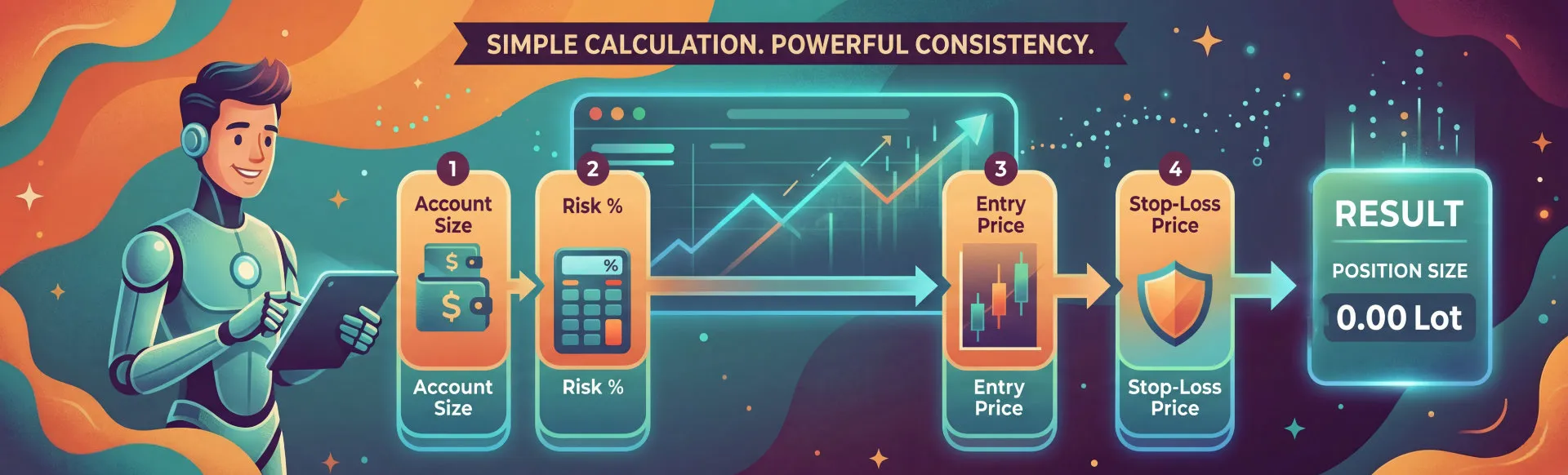
In most cases, you only need a few inputs:
Your account size
The percentage or amount you want to risk
Your entry price
Your stop-loss price
Once those numbers are in, the calculator tells you how much to buy or sell. That is why a good position size calculator is not just convenient. It protects consistency.
Instead of asking yourself vague questions like “Should I go a bit heavier here?” or “This looks good, maybe I can push size,” you work from a fixed risk model.
That shift changes a lot.
You stop trading based on mood.
You stop increasing size after a winning streak just because you feel sharp.
You stop trying to recover losses by forcing bigger positions.
You start treating risk like a rule, not a feeling.
That is where better trading begins.
A simple example traders can relate to
Let’s say two traders both have a $5,000 account.
The first trader sees a strong setup and enters with a random size because the trade “looks obvious.” Their stop is wider than usual, but they do not adjust size. The trade loses. Now they are down far more than they expected, and the next trade feels heavier emotionally.
The second trader uses a trading risk calculator before entering. They decide they will risk 1 percent, which is $50. Their stop-loss is 100 points away, so they size the trade accordingly. The trade also loses.
On the surface, both traders had the same market idea. But their experience is completely different.
The first trader feels shaken and starts doubting their system. The second trader takes the loss, logs it, and moves on. One is reacting to damage. The other is operating within plan.
That is the difference between random risk and structured risk.
Managing lot size is really about managing yourself
Many traders think risk management is just about protecting the account. That is true, but it is only half the story.
The other half is psychological.
When your size is too large, every candle feels personal. Every pullback feels threatening. You start watching your P&L more than the chart. You exit early when fear kicks in. You move stops because you cannot tolerate the loss. Or you hold losers too long because accepting the hit feels too painful.
When your size is right, the trade feels manageable. You can think more clearly. You can let the setup play out. You can respect your stop without drama.
That is why learning to manage lot size properly is not just a technical skill. It is part of emotional control. A trader with poor sizing usually ends up with poor decision-making. Not because they lack intelligence, but because the trade is too heavy for them to handle calmly.
Why this matters more than people think
A lot of traders look for growth by trying to make more.
The stronger ones usually focus on losing better first.
That may sound strange, but it is true. Good traders understand that losses are part of the game. What matters is whether those losses stay controlled. If one losing trade can hurt your confidence, distort your next decision, or wipe out a week of disciplined trading, then the issue is not just the loss. It is the sizing.
This is where risk management software becomes useful. Not because traders need more dashboards or more numbers on a screen, but because structure helps remove avoidable mistakes. A tool that helps you calculate size, define risk, and stay consistent can do more for long-term growth than another entry signal ever will.
Most traders do not fail because they never find good setups. They fail because they cannot repeat good behavior. And consistent sizing is one of the clearest signs of good behavior.
Small habits create better results
The traders who improve over time are usually not doing anything flashy.
They define risk before entry.
They use the same logic every time.
They keep sizing consistent.
They review whether they followed plan, not just whether they won.
That last part matters.
A well-sized losing trade is often a better trade than a badly sized winner. One follows process. The other rewards poor behavior. And in trading, poor behavior that gets rewarded can become dangerous very quickly.
This is why structured habits matter more than occasional big wins. A calculator may seem like a small tool, but the habit behind it is powerful. It teaches you to pause, quantify the risk, and act with intention.
That is what smart trade sizing really is. Not just finding the correct number, but building a repeatable way to protect yourself.
A better way to think before every trade
Before you enter your next position, stop asking only one question: “Does this setup look good?”
Ask a better one: “Does this setup still make sense once the risk is properly sized?”
That question changes the quality of your decisions.
It forces you to think like a trader who plans, not a trader who reacts. It keeps your focus on capital preservation, which is the part many people ignore until they need it. And it helps you stay steady enough to keep showing up with a clear head.
Because that is what long-term trading really demands. Not perfect entries. Not constant wins. Just the ability to take trades with clear risk, take losses without panic, and stay consistent long enough for your edge to matter.
The Big Picture
Trading gets a lot simpler when you stop treating risk like a side calculation and start treating it like part of the trade itself.
A position size calculator is not just there to save time. It helps you protect capital, stay consistent, and make better decisions under pressure. And when that process becomes routine, tools like ChartWise can make it even easier to stay structured and review your trading with more clarity.
If your sizing has been based on instinct, confidence, or guesswork, this is a good place to tighten things up. Sometimes one small shift in process changes everything.