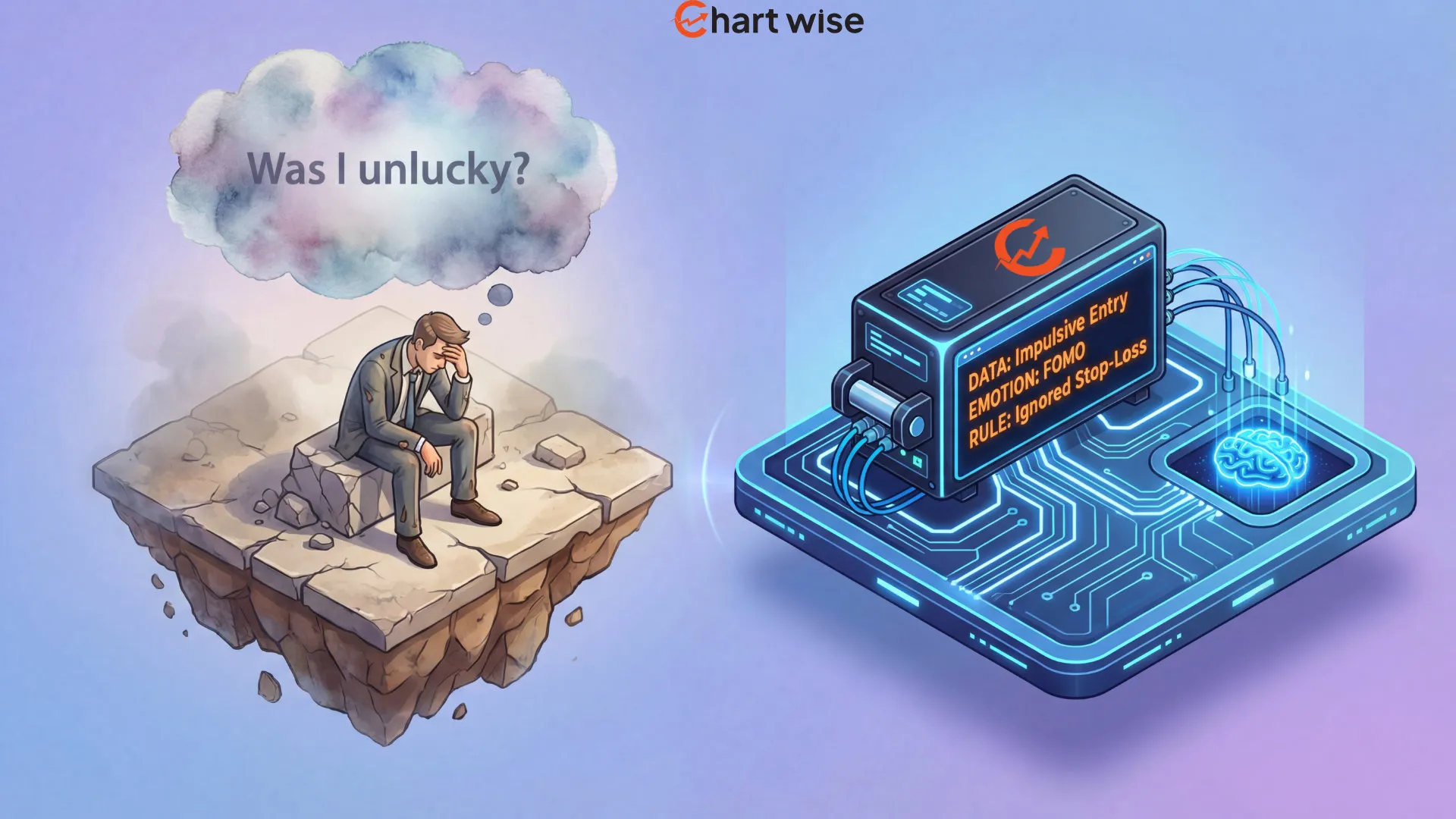
Most traders think trade journaling is about discipline.
Some think it’s about accountability.
A few think it’s just busywork for people who don’t trust their instincts.
All of them are missing the real point.
Trade journaling isn’t a productivity habit. It’s a psychological instrument. And when used correctly, it becomes one of the most reliable ways to generate genuine trading insights. Insights that don’t come from indicators, strategies, or market commentary, but from understanding how you behave under uncertainty.
Because the truth is uncomfortable:
Most trading mistakes aren’t technical. They’re behavioral. And behavior doesn’t show up on charts unless you force it into the open.
Journaling Is Not Writing. It’s Externalized Thinking
Let’s start by breaking a common illusion.
When traders say they “journal,” what they usually mean is recording trades: entry, exit, profit, loss. That’s bookkeeping. It’s not journaling.
Real trade journaling is the act of pulling decision-making out of your head and turning it into something you can inspect.
Your brain is fast, intuitive, emotional, and unreliable under stress. It forgets context. It edits memories. It softens mistakes and exaggerates good calls. When you trade, especially in fast markets, your mind is constantly rewriting the story of why you did what you did.
A journal stops that rewriting.
Once a thought is written down, your bias, your confidence level, your reason for entering, it stops being a feeling and becomes an object. Something you can compare, challenge, and revisit later.
That shift from experiencing decisions to observing decisions is where the psychology changes.
The Black Box Effect: Why Journals Reveal the Truth You’d Rather Avoid
In aviation, investigators don’t rely on pilot memory after an incident. They rely on black box data. Not because pilots are incompetent, but because memory becomes distorted under pressure.
Trading works the same way.
Losses feel personal. Wins feel deserved. Near-misses feel unlucky. Over time, memory turns into narrative. And narratives are dangerous, because they protect identity instead of revealing patterns.

A trade journal functions like a personal black box.
It captures “what you believed before the trade?” “What information did you act on?” “What emotions were present?”
What rules did you follow or quietly ignore?
Here’s the uncomfortable part:
The journal doesn’t exist to make you feel better. It exists to tell the truth.
And truth, especially about our own behavior, is something the brain actively resists.
Why Traders Avoid Journaling Even When They Know They Should
If journaling clearly leads to better trading insights, why do so many traders abandon it?
The answer isn’t laziness. It’s identity defense.
Every trader carries an internal image of who they are:
“I’m disciplined.”
“I’m patient.”
“I follow my plan.”
A journal has the power to quietly challenge that image.
When written evidence shows repeated impulsive trades, emotional exits, or rule-breaking after losses, the mind experiences cognitive discomfort. To protect itself, it does the easiest thing: it stops journaling.
This is why many traders are consistent with chart journaling for winning days, but mysteriously forget to journal losing streaks. The resistance is psychological, not procedural.
Ironically, the discomfort is a signal you’re doing it right.
Journaling as Debugging, Not Self-Criticism
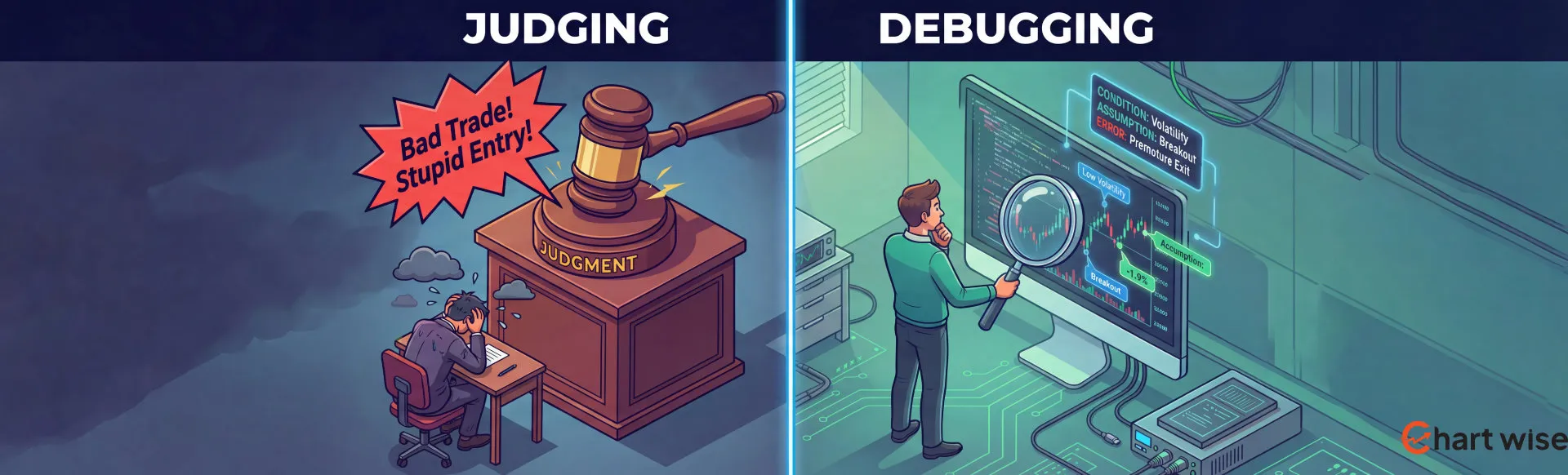
One of the biggest mistakes traders make is using their journal to judge themselves.
They write entries like:
“Bad trade”
“Stupid entry”
“Should’ve waited.”
That language turns the journal into a courtroom. And when the journal feels like punishment, consistency disappears.
A better mental model is debugging.
Engineers don’t ask whether code is “good” or “bad.” They ask what conditions produced the error. Trade journaling works the same way.
Instead of asking:
Was this trade good or bad?
You ask:
What information did I have at the moment I clicked buy or sell?
What assumption was I operating under?
What emotion was dominant?
What similar situations appear elsewhere in my journal?
This approach removes shame and replaces it with curiosity. And curiosity is sustainable.
How Journaling Changes Behavior Without Motivation
Here’s something most traders don’t expect.
Once journaling becomes a habit, behavior starts changing before analysis happens.
Not because you suddenly became disciplined. But because observation itself alters behavior.
When you know you’ll have to write:
“Entered out of boredom, no clear setup.”
Your brain hesitates. Even for half a second.
That pause matters.
This is where trading micro-habits come into play. Small journaling actions—one sentence, one checkbox, one emotion tag, create friction between impulse and execution. Over time, that friction filters out low-quality trades without effort.
You don’t need motivation. You need visibility.
When Trade Journaling Becomes Practical: Introducing ChartWise
Understanding the psychology of trade journaling is one thing. Applying it consistently, day after day, is another.
This is where most traders break down, not because they don’t believe in journaling, but because traditional tools turn reflection into friction. Too many fields. Too much manual effort. Too much distance between the chart, the decision, and the lesson.
That gap is exactly what ChartWise is designed to close.
There are hundreds of emotional trading solutions out there, but ChartWise approaches journaling the way experienced traders actually think. Instead of forcing long write-ups, it encourages bite-sized trade lessons built around real context. One chart. One insight. One lesson. That’s it. The focus stays on why the decision was made, not just how it turned out.
By anchoring reflection directly to charts, ChartWise makes chart journaling frictionless. You’re not reconstructing trades from memory or flipping between platforms. The decision, the emotion, and the market structure all live in one place, making the chart-based review feel natural instead of forced.
What really matters, though, is how it supports trading habits for growth. Small, repeatable actions, logging bias, tagging emotions, and noting a single execution mistake compound over time. ChartWise doesn’t push traders to journal more. It helps them journal better, using simplified journaling that respects how the brain works under pressure.
In that sense, ChartWise isn’t trying to teach traders what to think. It’s giving them a clearer mirror, one that makes patterns harder to ignore and easier to act on.
And that’s where real trading insights start to emerge: not from more information, but from seeing yourself clearly, trade after trade.
The Big Picture and the Insight Most Traders Miss
Most traders search for better entries. Journaling reveals something more valuable: conditions. You don’t need more strategies. You need fewer situations, fewer emotional states, and fewer market environments where you consistently underperform. Trade journaling makes this visible. And once it’s visible, improvement becomes subtraction, not addition. That’s the quiet power of simplified journaling done right.