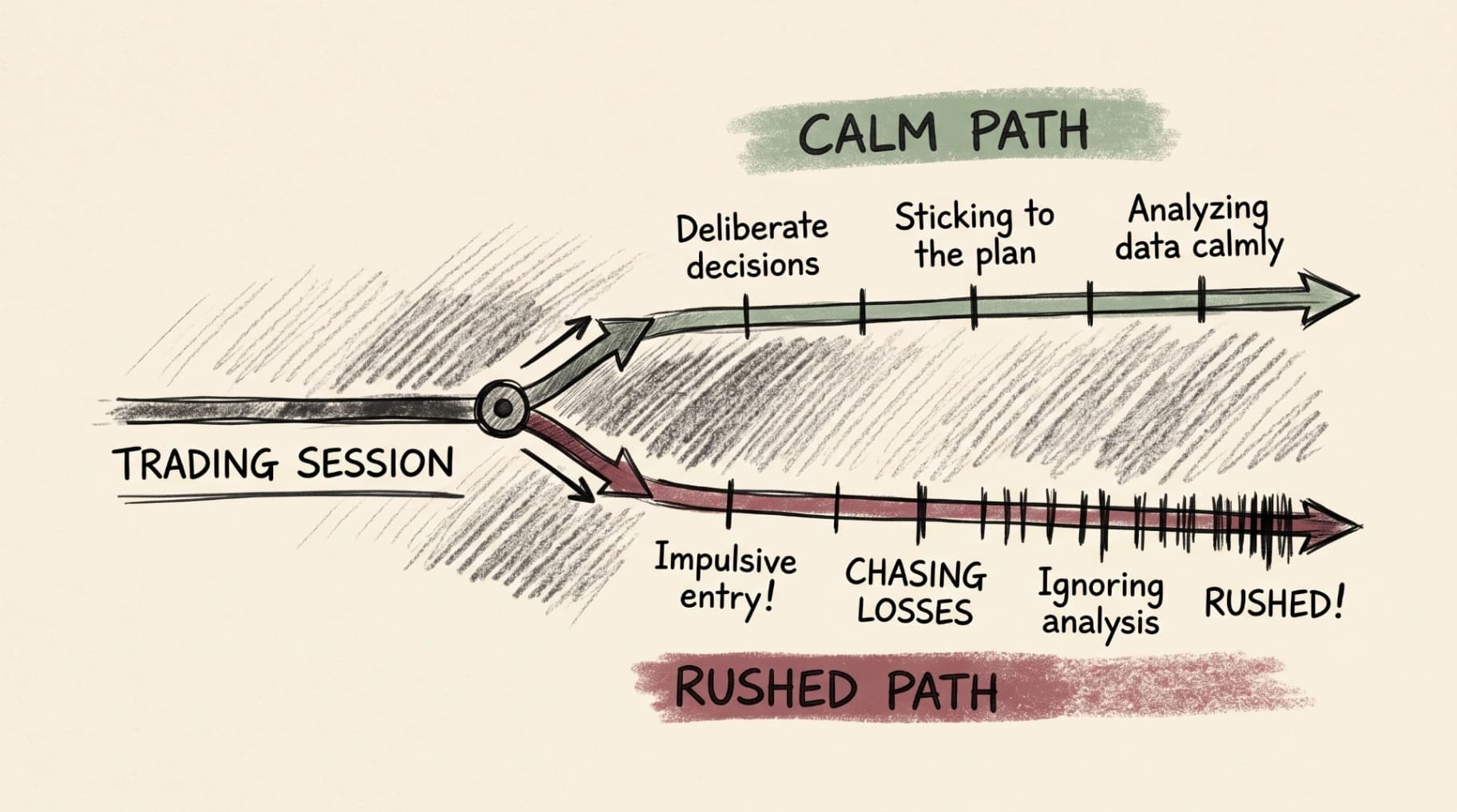
What Trading Tilt Actually Looks Like
Poker players named it first. Tilt is what happens when a setback stops being information and starts being personal. In trading, it shows up the same way. One trade goes against you, and instead of logging it and moving to the next setup with a clear head, something narrows. The next entry gets sized bigger. The stop gets moved. The plan that took weeks to build gets quietly set aside for a single afternoon of trying to make it back.
The strange part is that tilt rarely feels like tilt while it is happening. It feels like clarity. It feels like finally seeing the market for what it is. That confidence is exactly what makes it dangerous, and exactly why it is so hard to catch without something outside your own head keeping score.
The Moment Tilt Takes Over
There is usually a hinge point, a single trade that flips the session from disciplined to reactive. Before it, entries match the plan and sizing stays consistent. After it, entries start arriving faster, closer together, and further from anything written down in advance.
This is also where overtrading solutions and tilt start to overlap. Overtrading is often the visible symptom. Tilt is the state underneath it, the reason the next trade feels urgent instead of optional.
Why Smart Traders Tilt Anyway
Tilt is not a skill gap. Traders with years of screen time and a solid grasp of trading psychology tools still tilt, because the trigger is not technical. It is the gap between how the day was supposed to go and how it is actually going.
A few patterns show up again and again:
Chasing symmetry. A rough trade creates an urge to immediately take one back, as if the next setup owes you something.
Proving a point. The market feels like it made a call about your ability, and the very next trade becomes an argument you are trying to win.
Fatigue disguised as focus. Late in a long session, narrowed attention can feel like sharpness when it is actually depletion.
None of these show up as a single dramatic decision. They show up as a series of small ones that, taken together, look nothing like the plan from that morning.
The Three Tells You Can Actually Track
Tilt is hard to catch by feel, because feel is exactly what it distorts. It is much easier to catch in a pattern, which is why a written record matters more here than almost anywhere else in trading.
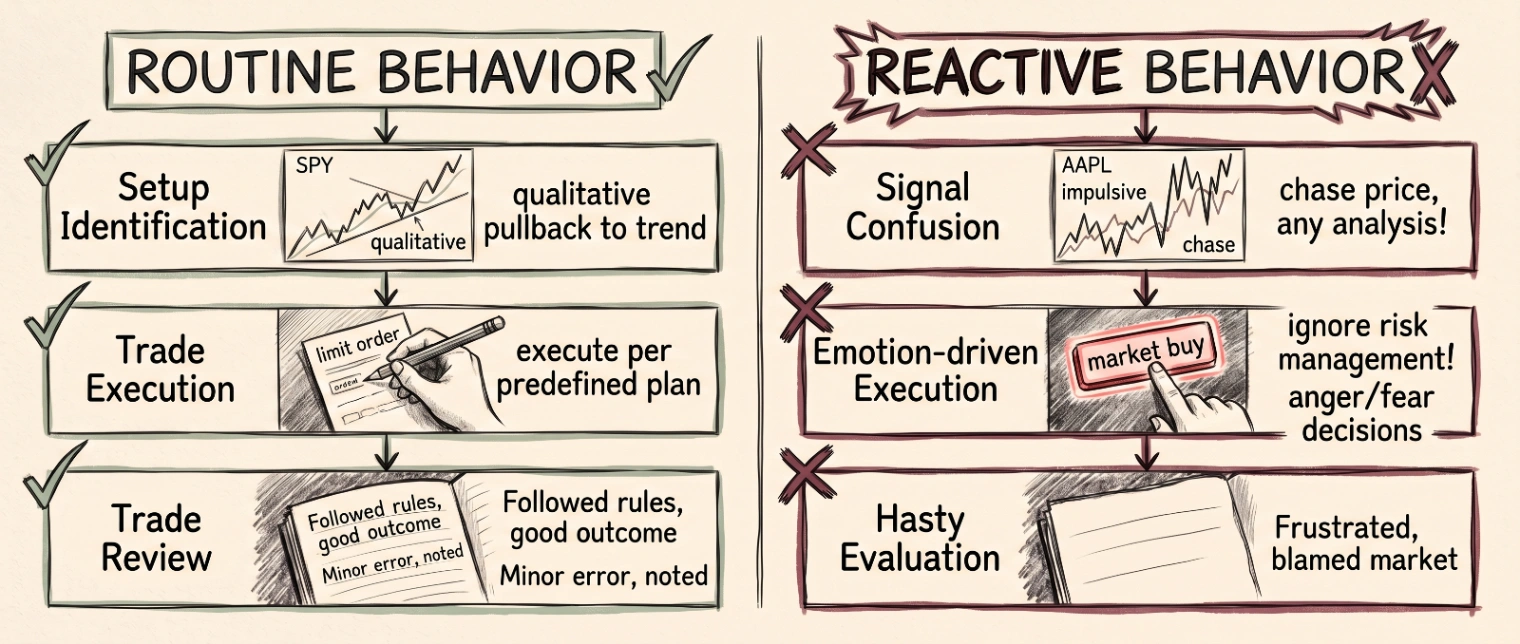
Three things tend to show up in the log right before a tilt episode, and each is something a routine can flag on its own:
Entry frequency climbing without a matching increase in setups that actually meet the plan's criteria
Sizing drifting upward mid-session with no written justification tied back to the original risk framework
Time between trades shrinking, often the clearest early signal, since a rushed re-entry rarely comes from a fresh, calm read of the chart
Catching any one of these on its own is useful. Catching the combination, in the moment rather than after the session closes, is what actually breaks the pattern before it compounds.
Breaking Tilt Before It Breaks Your Account
The traders who recover from tilt fastest are not the ones with the most willpower. They are the ones with a pre-built rule for what happens the moment the pattern shows up, so there is nothing left to decide in the heat of it.
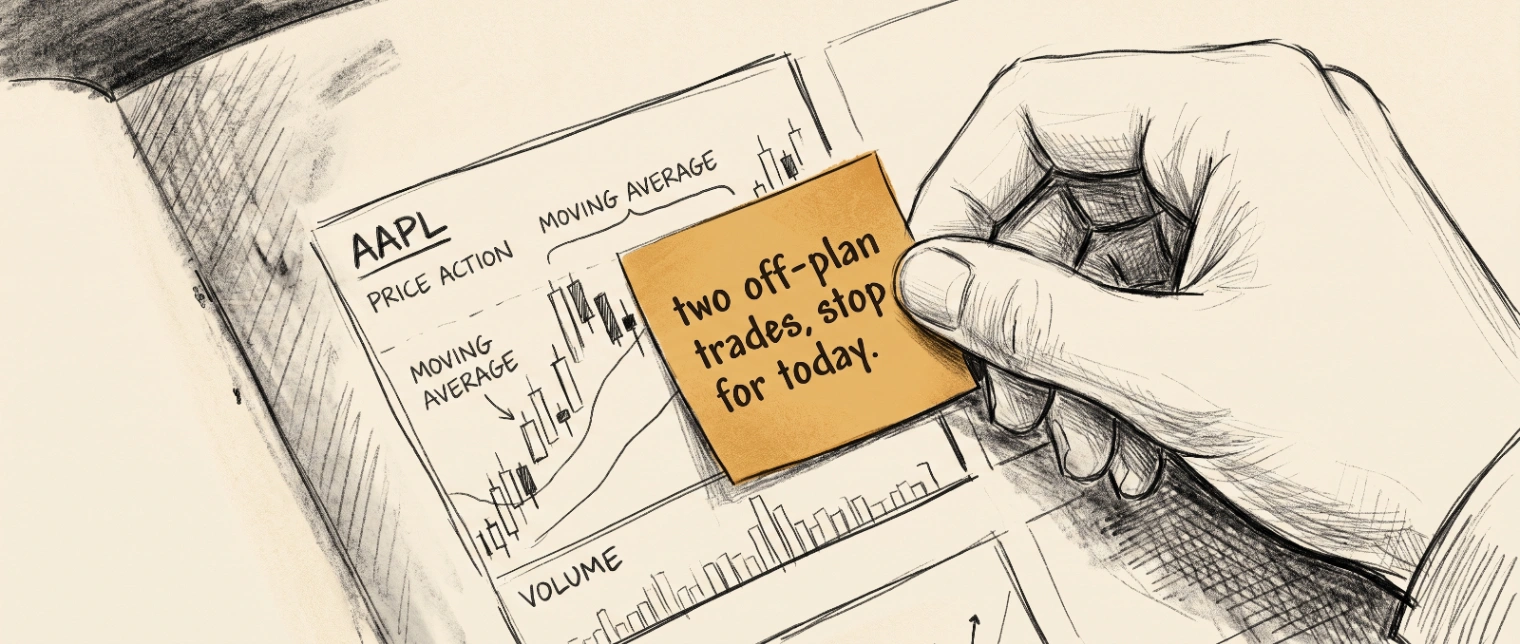
A workable version looks like this: two trades outside the plan in one session triggers an automatic stop for the day, no exceptions and no reassessment mid-session. That rule only holds if it is visible and checked in real time, not reconstructed from memory after the close. This is also where the overlap with revenge trading becomes obvious. Revenge trading is often just tilt that was never caught, given enough time to escalate.
Building a Tilt-Proof Routine
The traders who manage tilt well are not the ones who never feel it. Everyone feels it. The difference is a routine that catches the shift in behavior before the feeling has a chance to run the account for the rest of the day.
That starts with a written plan, a size ceiling that does not move mid-session, and a log that shows the pattern in numbers rather than memory. Combine that with the kind of trading discipline built through consistent review, and tilt stops being something that happens to you and becomes something you can see coming from two trades away.
FAQ
What is trading tilt?
Trading tilt is a shift in decision-making that follows an emotionally charged trade, usually a losing one, where entries become faster, sizing drifts upward, and the original plan gets quietly abandoned in favor of trying to force a different outcome.
How is tilt different from overtrading?
Overtrading describes the behavior, too many trades taken in too short a window. Tilt describes the underlying state that often causes it. A trader can overtrade without being on tilt, but tilt almost always produces overtrading as a symptom.
What is the fastest way to notice tilt while it is happening?
Watch the gap between trades. A sudden drop in the time between entries is one of the earliest and most reliable tells, often showing up before sizing or entry frequency changes are obvious.
Can a trading journal actually prevent tilt?
A journal cannot prevent the feeling, but it can catch the pattern early by comparing live entry frequency and sizing against your baseline plan, which is often faster than noticing the shift by feel alone.
Is tilt something only new traders deal with?
No. Tilt is tied to emotional state, not experience level, which is why experienced traders with solid technical skill still tilt under the right conditions. Time in the market reduces frequency, not immunity.