If you have ever blown up an account, exited a trade too early, or felt like your results swing up and down with no pattern, you are not alone. Many traders lose money, and it is rarely because the market is unfair. Most of the time the real problem is the trader’s own behavior.
You might think it is bad luck or that the market is targeting your stops. It feels easier to blame the outside world than to look at your own decisions. The real issue is that you do not clearly see the patterns behind your choices. You repeat the same mistakes because you never slow down and review them.
This is where a simple structure can change everything. A focused seven-day trading journal challenge gives you a clear way to see what you are doing, why you are doing it, and how to change it.
Instead of trading on autopilot for weeks, you commit to one week of honest review. You follow a trade review process every day. You start to build real trading discipline habits based on facts, not feelings.
Why traders keep losing without seeing it
Most traders do not fail because they cannot read charts. They fail because they do not read themselves.
They trade without rules, they react to emotions, and they never build a feedback loop. Over time this creates the same outcome. Inconsistent results and growing frustration.
Here are the silent drivers behind that:
Lack of structure: Many traders shift style from day to day. One day you scalp short time frames. The next day you hold positions overnight. There is no defined strategy, no fixed risk plan, and no clear entry criteria.
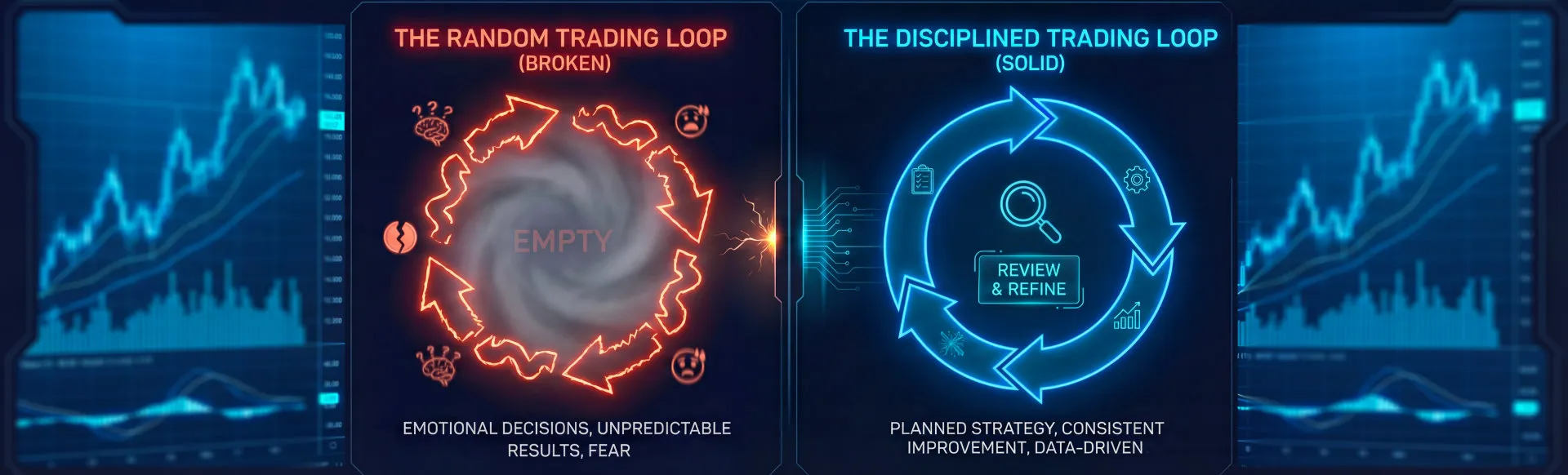
Without structure, each trade is a new idea with no link to the last one. When a trade moves against you, you do not know if you should hold, exit, or add. There is no plan to guide the decision. Over time this kind of random trading drains your account.
Emotional bias: Revenge trading after a loss. Fear of missing out when the price moves without you. Greed is when you refuse to take profit. These are all common. They are also extremely expensive.
You cannot solve emotional trading by telling yourself to stay calm. You need visible evidence of when emotions start to control your actions. Until you see those moments on record, you will keep falling into the same traps. If you want to improve trading psychology, you need data on your own behavior.
No feedback loop: Imagine trying to improve your fitness without ever checking your progress. You would not track your training or your food. You would just hope that something changes.
This is how many traders treat their work. They place trades, accept wins and losses, and never look back. There is no weekly trading review, no structured trade review process, and no record of what worked and what did not. Without a feedback loop, mistakes repeat by default.
Overtrading and weak discipline: Overtrading feels active. You feel busy and engaged. You open many positions and feel productive. In reality, more trades often mean more fees, more noise, and more stress.
You start to take setups that do not match your plan. You chase moves that are already gone. Each time you do this, you train yourself to ignore your own rules. Discipline becomes weaker, not stronger.
Poor risk management: Risk is often the last thing traders think about and the first thing that hurts them. Oversized positions, moved stops, and “double or nothing” trades after a loss are common behaviors.
You can have a decent win rate and still lose money if one or two trades are far too large. Without clear risk rules and real tracking, those trades will appear again.
The Root Problem
All of these issues share one root cause. You do not have a clear way to see what is actually happening in your trading.
You rely on memory instead of records. You guess instead of measuring. You judge your week by profit and loss instead of process.
You cannot fix what you do not measure. If you want to change your trading, you need a simple way to track your actions, emotions, and results. This is where a trading journal challenge comes in.
What a trading journal challenge does for you
A trading journal challenge is a focused period where you log every trade, every day, and review it. You write down the setup, the reason for entry, the exit, and what you felt during the trade. You do this consistently for a defined window of time.
Over seven days that journal becomes a mirror. It shows you patterns that are not visible on a bare P and L line.
You see which strategies actually make money for you.
You see how often emotions change your plans.
You see how many trades do not match your own rules.
The goal is not to create a perfect diary. The goal is to build a simple journaling routine for traders that gives you clarity. Once you see the real story behind your trading, you can start to change it.
Why a 7-day challenge works
You may like the idea of journaling, but a vague plan such as “I will start reviewing more” easily fades. A seven-day challenge is different.
It has a clear start and end. You only commit for one week. That feels realistic.
It keeps things fresh. You review trades while you still remember what you saw and felt.
It creates momentum. After seven days, review feels normal instead of extra work.
During that week you get a focused look at your behavior. That is enough to catch major patterns and begin new trading discipline habits.
The 7-day trade review process
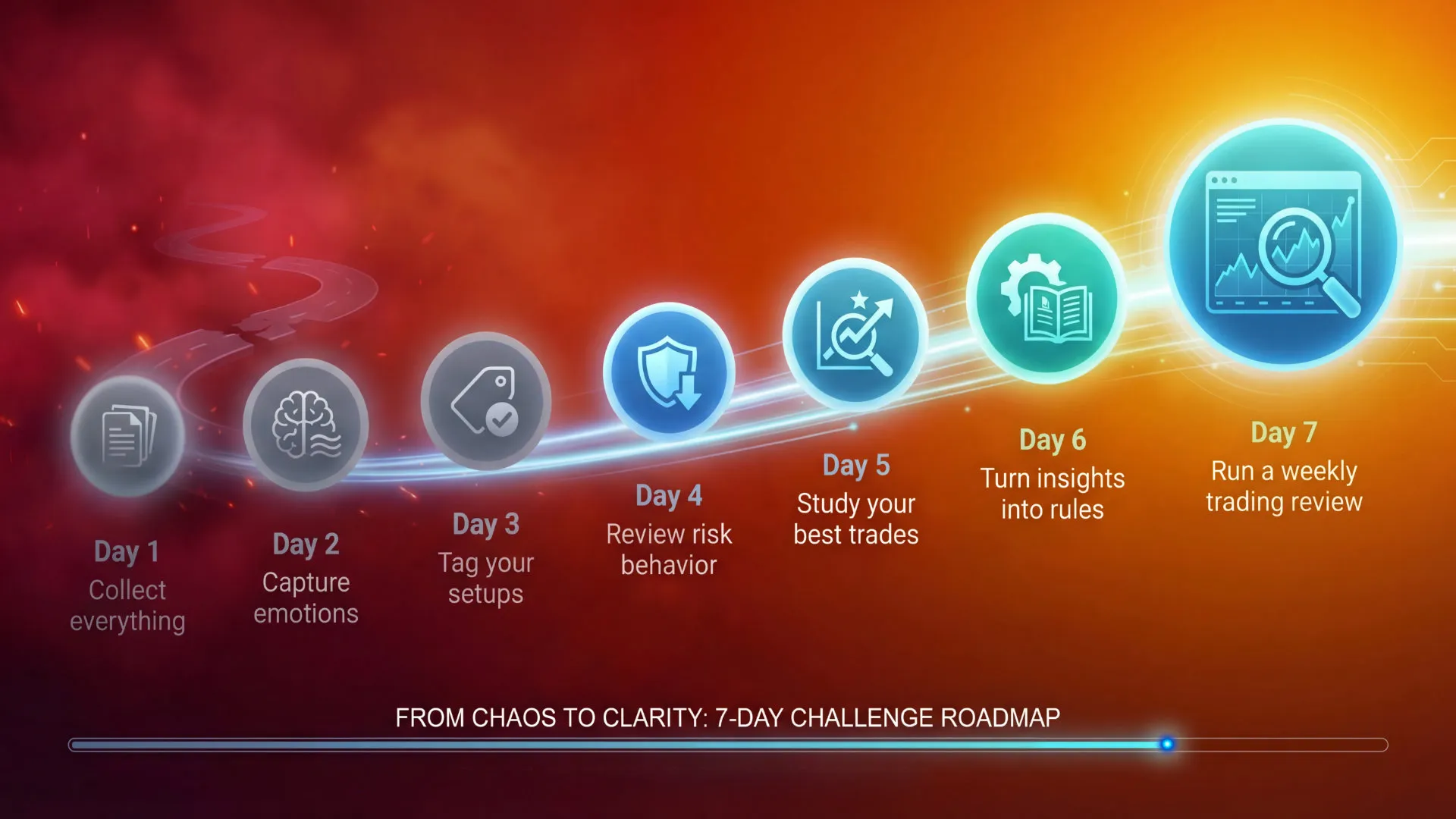
Here is how you can run a 7-day trade review challenge in a practical way.
Day 1 Collect everything
You put all your trades into one place. This can be a digital tool like ChartWise or any journal you can maintain. The key is that nothing is left out.
For each trade, you record what you traded, why you entered, where you planned to exit, and how the trade ended. You do not judge or explain yet. You just collect.
By the end of day one, you have a full list of your recent actions. No gaps. No hidden trades.
Day 2 Capture emotions
On day two you go back over the same trades and add emotional notes. You write how you felt before, during, and after each trade.
You might notice you felt stressed after a loss, overconfident after a win, or bored during slow periods. You write it down in simple words.
This step helps you improve trading psychology with real examples. You start to see where emotions push you into low-quality decisions.
Day 3 Tag your setups
On day three you define your setups. You group trades into types such as breakout, pullback, range trade, trend follow, or news reaction.
You tag each trade with one setup. If you cannot label a trade, that is a signal. It may mean the trade was random and not part of any real plan.
Once trades have setup tags, you can see which ideas have an edge and which do not. Your trade review process now has structure.

Day 4 Review risk behavior
On day four you focus on risk. You check if you followed your own limits. Did you stick to your planned risk per trade? Did you move stops? Did you add size without planning?
You look for trades where the size or risk is different from your rules. These trades often cause most of the damage.
This step gives you clear input for new trading discipline habits. You can define simple rules such as “no adding to losing trades” or “stop trading for the day after three losses”.
Day 5 Study your best trades
On day five you look at your best behaved trades. Not just the biggest winners, but the trades where you followed your plan from start to finish.
You ask what was clear about these trades. Was the setup clean. Was the risk defined. Did you feel calm and in control.
This helps you understand what good trading looks like for you. Your journal now holds examples you can model in the future.
Day 6 Turn insights into rules
On day six you write new rules based on what you saw. These rules should be simple and specific.
You might decide not to trade during certain times where you often make mistakes. You might limit yourself to a set number of trades per day. You might commit to only trade defined setups for the next month.
You write these rules in your journal and keep them visible. They now come from your own data, not from someone else’s advice.
Day 7 Run a weekly trading review
On day seven you zoom out and review the whole week. You ask three questions.
What worked well.
What created repeated problems.
What will I change next week.
You write a short paragraph to answer each one. That is your first weekly trading review. If you repeat this every week, you build a strong feedback loop that keeps you improving.
Where chartwise fits into this
You can run this trading journal challenge with pen and paper or a simple spreadsheet. Many traders start that way. The main issue is consistency. Manual journaling is slow. It feels like extra work. Most people stop.
ChartWise exists to remove that friction. It is a trading journal and analytics platform that helps you run this whole process with less effort.
You can sync trades from your broker. You can add notes, tags, and screenshots in a few clicks. You can see performance by setup, time of day, or symbol without building your own reports.
ChartWise is more than a log; it is a personal trading intelligence system. It shows you how your strategies, your risk decisions, and your emotions connect. It supports your journaling routine for traders and makes a weekly trading review easy to maintain.
How chartwise turns 7 days into real change
When you use ChartWise during a 7-day trade review challenge, you get several benefits.
You see blind spots that are hard to notice on your own. For example, you may learn that most of your losses come from one specific setup or time of day.
You break emotional loops because you can see exactly when revenge trading or fear of missing out appears.
You refine strategies based on evidence. You keep the setups that work and stop using the ones that only feel good.
You trade with more confidence because your decisions are backed by data, not guesses.
You save time. The platform handles imports and calculations so you can focus on learning and planning.
The Big Picture
Most traders lose money because they trade without clarity. They do not have a clear trade review process. They do not track their behavior. They repeat the same errors and hope that results will change on their own.
A trading journal challenge is a direct way to break that pattern. Seven days of honest review can give you more insight than months of blind trading.
You can run this challenge with any tool, but a platform like ChartWise makes it far easier to stick to. It supports your trading discipline habits, helps you improve trading psychology, and turns review into a simple routine instead of a heavy task.
If you are tired of guessing why your results are inconsistent, start with one week. Log every trade. Review every day. Learn from your own data. That is how you move from random outcomes to a deliberate process.