
Ever finish a trading day feeling drained but oddly unsatisfied, even after putting in real effort?
You watched the charts, reviewed the trades, and took notes, yet you still can’t clearly explain what you learned.
That frustration is common and easy to miss.
Somewhere between collecting data and trying to interpret it, the signal fades into noise.
When that happens, many traders assume they need better tools or strategies, but the real issue is often simpler.
It’s not about doing more. It’s about how experience gets processed into trading insights.
Why too much information slows progress
Most traders aren’t short on information; they’re buried under it.
Charts stack up, trades blur together, and notes grow longer, but learning somehow thins out.
You review your trades, sense that something went wrong, and then repeat the same mistakes. Over time, confidence erodes and clarity slips.
This is usually when traders chase a new strategy, even though the strategy often isn’t the problem. The real gap is learning how to extract meaningful trading insights from what you’re already doing.
A simple framework for real trading days
That’s where One Chart, One Insight, and One Lesson fit. It’s a micro-journaling approach designed for real trading days, the imperfect ones with limited time, scattered focus, and heightened emotion.
Instead of demanding more effort, it asks for less while delivering clearer feedback through simplified journaling.
You don’t record everything; you isolate what matters most. One chart. One insight. One lesson. Less noise, more clarity, and learning that actually sticks.
Why traditional journaling breaks down
Traditional journals can look impressive with first rows of numbers, tagged emotions, screenshots for every trade, and detailed commentary.
But most traders abandon them within weeks, not out of laziness, but because the process doesn’t match the emotional reality of trading.
After a rough session, writing a long breakdown feels exhausting.
Entries get rushed, reviews are skipped, and patterns slip by unnoticed, even during what should be a thoughtful chart-based review.

The value of narrowing your focus
Micro-journaling works because it respects attention.
You don’t need more detail; you need the right detail, captured consistently. A single chart already contains context, structure, timing, entry logic, and outcome.
When you focus on one chart, excuses disappear. You stop hiding behind the rest of the day or blaming the market and instead examine the exact moment a decision was made and why through chart journaling.
Letting the chart tell the truth
This is when chart journaling becomes powerful.
Charts don’t argue or soften the truth.
They show whether your entry was patient or rushed, whether structure supported the trade or impulse drove it, and whether rules were followed or quietly rewritten mid-trade.
With regular chart-based review, repetition becomes obvious.
And repetition matters, because when patterns in your behavior become visible, predictability follows, and predictability is where real insight lives.
What real insights actually look like
An insight isn’t “bad trade” or “should’ve waited.”
That’s commentary.
A real insight reshapes future decisions.
You might realize you enter early because you confuse momentum with confirmation, or that you trade clean setups but sabotage them with aggressive management.
You may notice your worst trades cluster after a couple of wins, when confidence gets ahead of discipline.
These realizations don’t come from data alone; they come from focused review and repeated bite-sized trade lessons.
When journaling starts guiding decisions
As insights stack, your journal changes purpose. It stops being a record of the past and becomes a guide for the future.
You begin to recognize triggers and blind spots the same way you recognize chart patterns.
That’s why simplified journaling works. It’s not about writing more; it’s about seeing more clearly.
Why lessons create real change
Awareness alone isn’t enough, though.
Many traders spot the issue, acknowledge it, and repeat it the next day.
Insight without a lesson doesn’t change behavior.
A lesson must be simple, specific, and actionable.
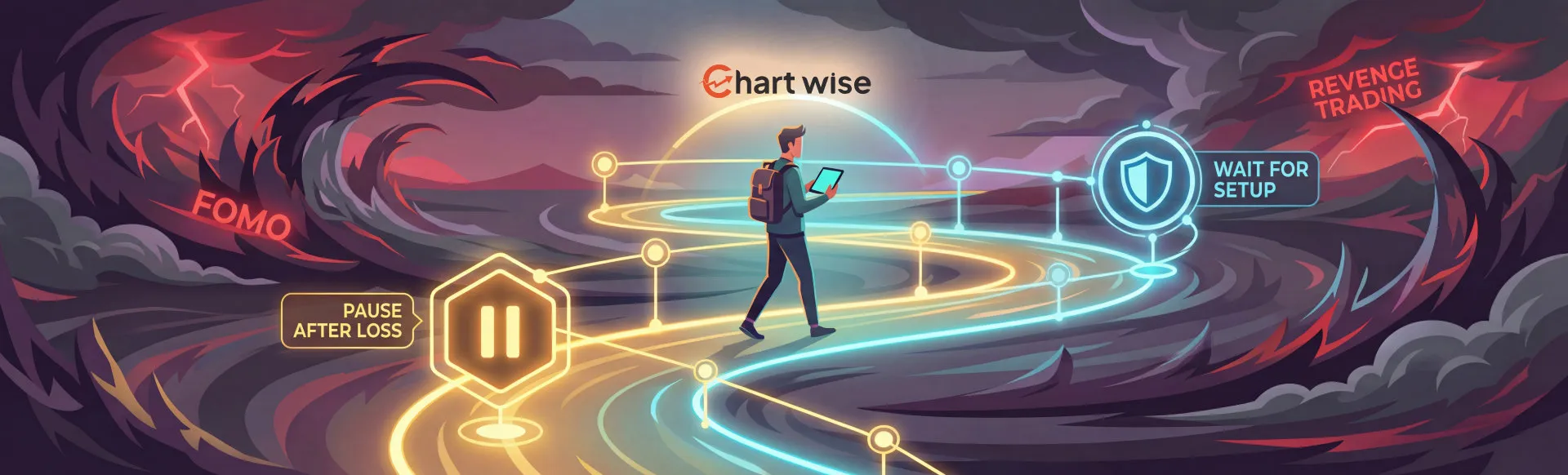
Instead of “be more disciplined,” the lesson becomes “after my first losing trade, I step away for five minutes.”
Instead of “avoid FOMO,” it becomes “no entries unless the price pulls back into the structure.”
These small rules evolve into trading micro-habits.
How small rules support consistency
Micro-habits don’t rely on motivation; they create guardrails.
Over time, these rules stack quietly.
Trading feels calmer, decisions slow down, and execution improves not because you changed who you are, but because your process stopped working against you.
That’s how consistent improvement happens.
Catching overtrading before it compounds
This approach is especially effective for overtrading, which thrives when feedback is delayed.
In the moment, extra trades feel productive, and busy feels controlled.
The real cost shows up later through slippage, commissions, and emotional fatigue.
Micro-journaling shortens that feedback loop.
When you review one chart and ask whether the trade was necessary, the answer is often immediate.
When the same unnecessary trade appears repeatedly, it becomes harder to justify.
A trade review that changes behavior
Consider a simple example.
After a messy session, instead of reviewing everything, you pick the trade that felt most avoidable.
You pull up the chart and see that price was extended and structure hadn’t reset, yet you entered anyway because you didn’t want to miss the move.
The insight is clear: fear of missing out drove the decision.
The lesson becomes actionable: wait for pullbacks into structure.
One chart, one insight, and one lesson are often more valuable than pages of notes.
Why shorter reviews work better
That’s why smaller reviews work better.
Bite-sized lessons are easier to repeat, remember, and maintain.
A journal you keep consistently will always outperform a perfect journal you abandon after two weeks.
Over time, learning compounds quietly.
One chart grounds you, one insight sharpens awareness, and one lesson nudges behavior.
Trades become cleaner, decisions slow down, and mistakes become familiar enough to stop before they get expensive.
Where Chartwise fits into the process
Many traders use tools like Chartwise to support this focused approach.
Chartwise brings charts, notes, and context into one place, removing the friction of scattered files and half-remembered decisions.
With Chartwise, reviewing why a trade was taken becomes clearer and more objective, and patterns surface without forcing longer reviews.
For traders who want consistency without complexity, Chartwise fits naturally into micro-journaling and can simplify how you review and learn from trades.
The Big Picture
What makes this approach effective isn’t its structure but its restraint.
By limiting reflection to one chart, one insight, and one lesson, you create space for understanding instead of overwhelm.
Awareness builds quietly, trade by trade, until better decisions feel natural rather than forced.
And that, more than any setup or strategy, is what sustains long-term progress in trading.