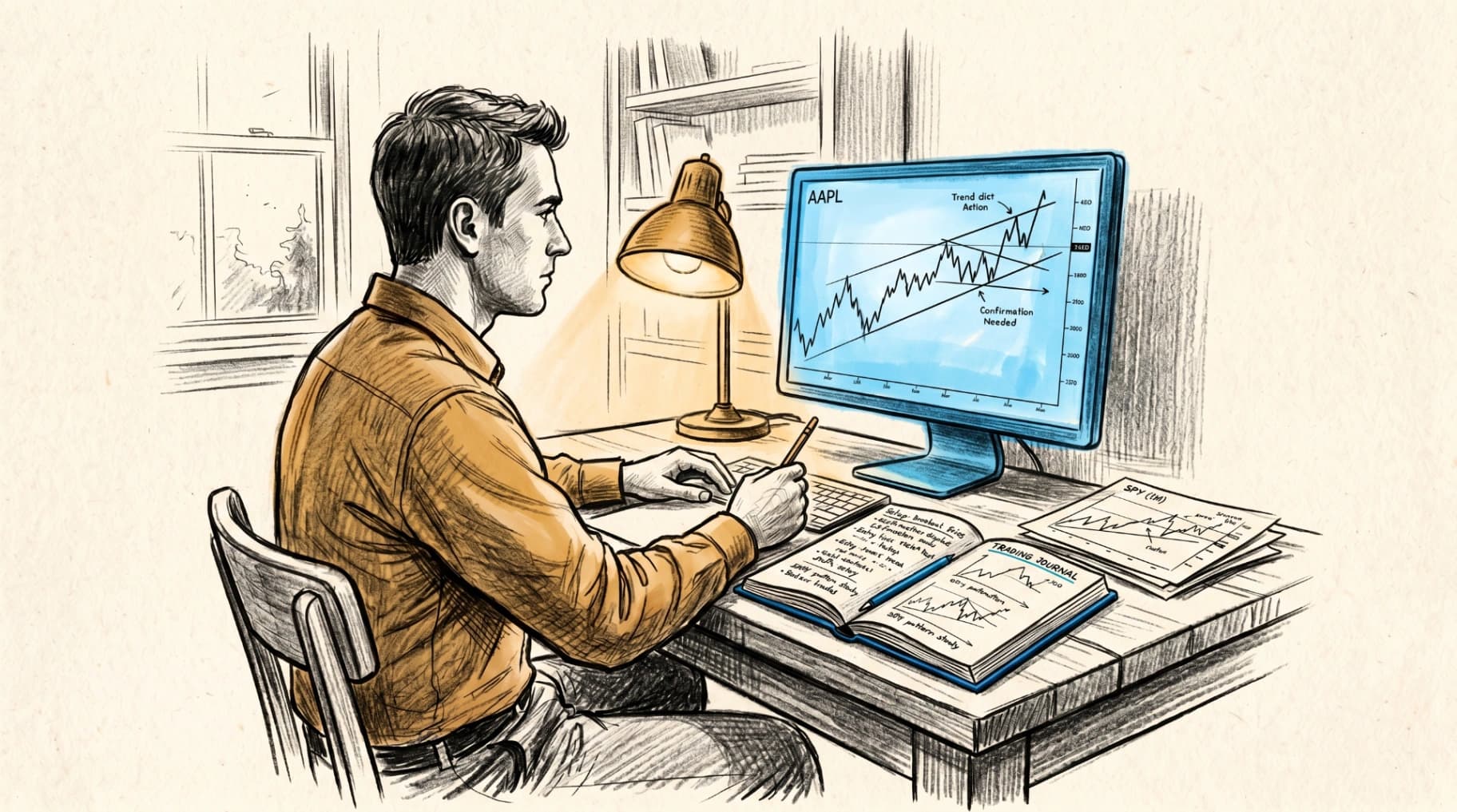
Most traders use paper trading to test strategies. Few use it to study themselves.
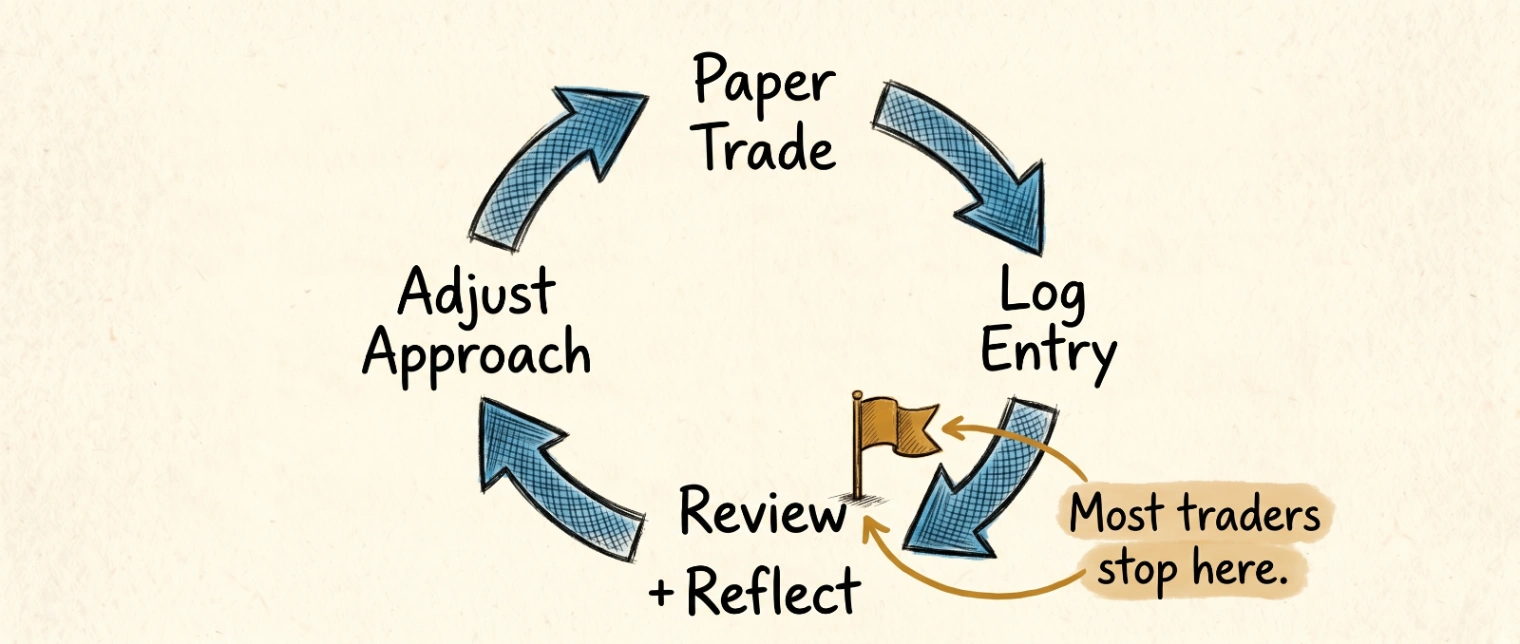
That gap is where improvement stalls. Paper trading gives you a low-stakes environment to practice execution, test setups, and explore different markets. But without a structured journal, you walk away with results, not lessons. You know what worked and what did not. You rarely understand why.
A paper trading journal changes that. It turns practice into a repeatable learning process, one that prepares you for live trading in a way that tracking numbers alone never will. If you are already using trade journaling software for your live account, applying the same structure to your paper trading phase is one of the highest-leverage habits you can build.
What Is a Paper Trading Journal
A paper trading journal is a structured record of your simulated trades: the decisions behind them, the conditions around them, and your behavioral patterns across practice sessions.
It goes beyond logging entry and exit prices. A proper paper trading journal captures what you were thinking before the trade, how you managed it while it was open, and what you noticed after it closed.
The goal is not just to see whether a strategy produces results in simulation. It is to understand how you execute that strategy under different conditions, and where your decision-making breaks down before real capital is on the line.
Why Paper Trading Without a Journal Is Mostly Wasted Practice
There is a version of paper trading that almost every beginner goes through. You open a demo account. You take trades. You watch the numbers move. Eventually, you feel ready. You go live. And something completely different happens.
The market did not change. The strategy did not change. The trader changed. And without a journal, there was no way to see that coming.
Paper trading without recording your decisions teaches you the outcomes of a strategy without teaching you how to execute it consistently under pressure. You learn the pattern, not the process.
When traders journal their paper trades properly, they catch things that results miss. They notice that they exit winning trades too early because they do not trust the setup. They see that they skip setups entirely on volatile mornings. They find that their sizing gets larger after a winning streak, even in simulation.
These are not strategy problems. They are behavioral patterns. And the earlier you see them, the less they cost you. This is the same principle behind effective trading psychology tools: surface the behavior before it becomes an expensive habit.
What to Log in a Paper Trading Journal
Most traders log the basics: instrument, entry price, exit price, position size, and outcome. That captures what happened. It does not capture why.
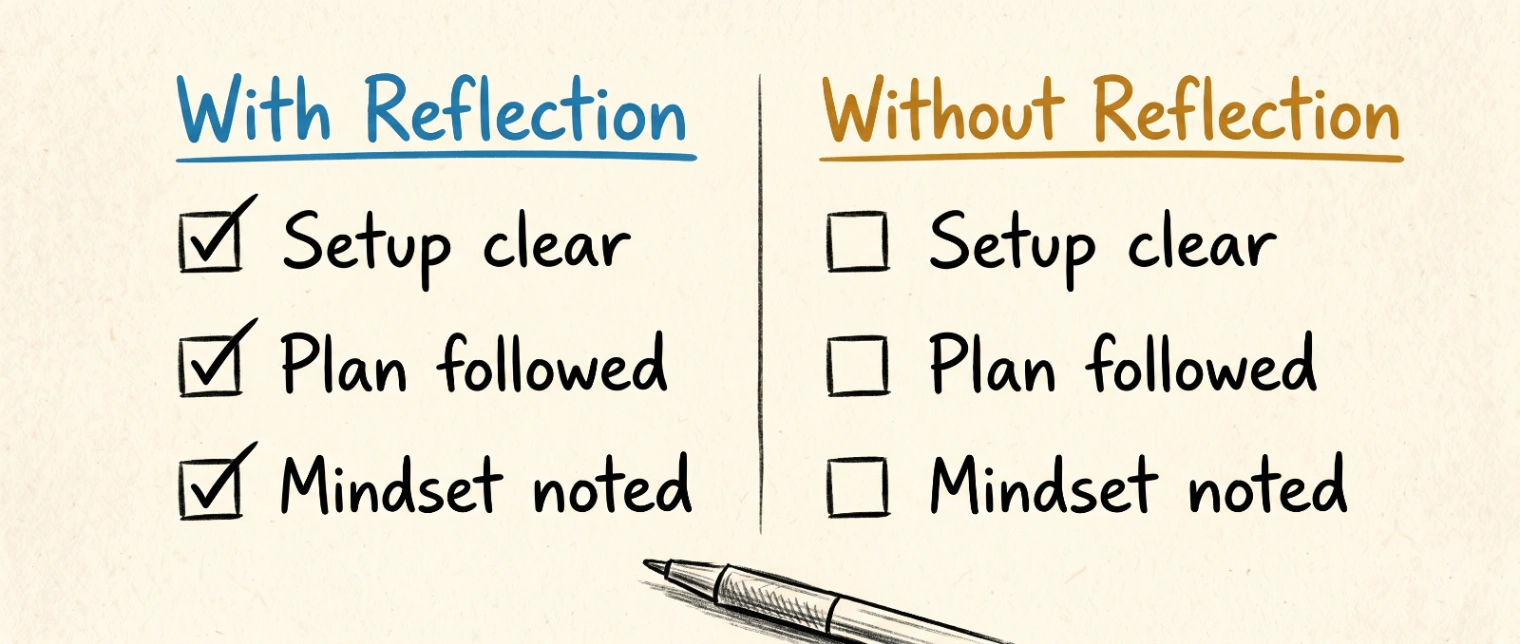
A useful paper trading journal entry includes the following.
The setup criteria.
What specifically triggered the trade? Was it a technical signal, a pattern, or a confluence of conditions? Writing this out forces clarity. If you cannot describe the setup in one or two sentences, you probably did not have a clear reason to enter.
Pre-trade mindset.
How were you feeling before the trade? Were you impatient, confident, uncertain, or bored? Emotional context often predicts execution quality more than the chart setup does. This connects directly to your pre-trade planning routine.
Execution notes.
Did you enter at the planned level? Did you adjust the position during the trade? Did you exit according to the plan or override it? The gap between plan and execution is where most traders develop their biggest blind spots.
Post-trade reflection.
Not just whether the trade worked, but whether you traded it well. A trade can close in your favor and still be a poor execution. Separating process from outcome is one of the core disciplines a paper trading journal builds.
Market conditions.
Note the broader context. Was the market trending or ranging? Was volatility elevated? Were there news events nearby? This helps you understand which conditions favor your setup and which ones erode it.
How to Structure Your Paper Trading Journal Entries
Consistency matters more than complexity. A simple journal you fill in after every practice session is more valuable than an elaborate one you use once a week.
A basic structure that works:
Date and session.
When did you trade and what session were you active in? Instrument and setup type. What did you trade and what was the signal? Entry rationale. A few sentences on why you took the trade. Execution quality. Did you follow the plan? Where did you deviate? Outcome and key observation. What happened and what did you notice? One thing to carry forward. A single behavioral note for your next session.
The last part is the most important. A paper trading journal that does not produce a forward-looking takeaway is just an archive. The purpose is to feed your next session with one honest observation about your decision-making.
This structure applies whether you are keeping a day trading journal, a stock trading journal, or a forex trading journal. The market changes; the framework stays consistent.
Common Mistakes Traders Make in Paper Trading Journals
Only logging the trades that worked. This is the most common mistake and the most damaging one. A journal built from your best moments does not reflect your actual behavior. It reflects the version of yourself you want to believe in.
Treating paper results as the measure of readiness. High simulated performance can mask poor execution habits if conditions were favorable. What matters more is consistency of process: did you follow your rules, manage the trade correctly, and reflect afterward?
Skipping entries after difficult sessions. The sessions that sting are often the most revealing. Avoiding them in your journal means avoiding the feedback that would help most.
Journaling days later. Context fades fast. Write your reflections close to the session, while the emotional texture of each decision is still accessible. This is where real behavioral patterns surface.
Not connecting paper trading observations to live trading preparation. The whole point of journaling paper trades is to identify what needs work before real capital is involved. Periodically review your journal for recurring patterns, then design your next practice sessions around addressing them. This review habit is just as important as learning how to backtest a trading strategy properly.
When Are You Ready to Go Live
This is a question most traders answer too early. They look at a favorable streak in their paper account and take it as confirmation.
A paper trading journal gives you better signals than a result does. You are ready to transition to live trading not when your results look good, but when your process is consistent.
Ask yourself a few honest questions:
Are you following your setup criteria every time, or are trades still getting forced? Are positions being managed according to plan, or do adjustments happen under emotional pressure? Are the same behavioral patterns from week one still showing up in week four?
If your journal shows that decision-making is stable across different conditions, that is a stronger signal than any simulated result.
Some traders run their paper journal alongside a small live account during the transition. The contrast between how behavior shows up in simulation versus with real stakes often reveals the final gaps that practice alone could not surface.
How ChartWise Supports Paper Trading Journaling
ChartWise is built for traders who take the process seriously. Whether you are in your first week of paper trading or preparing for a live account, ChartWise captures more than entries and exits.
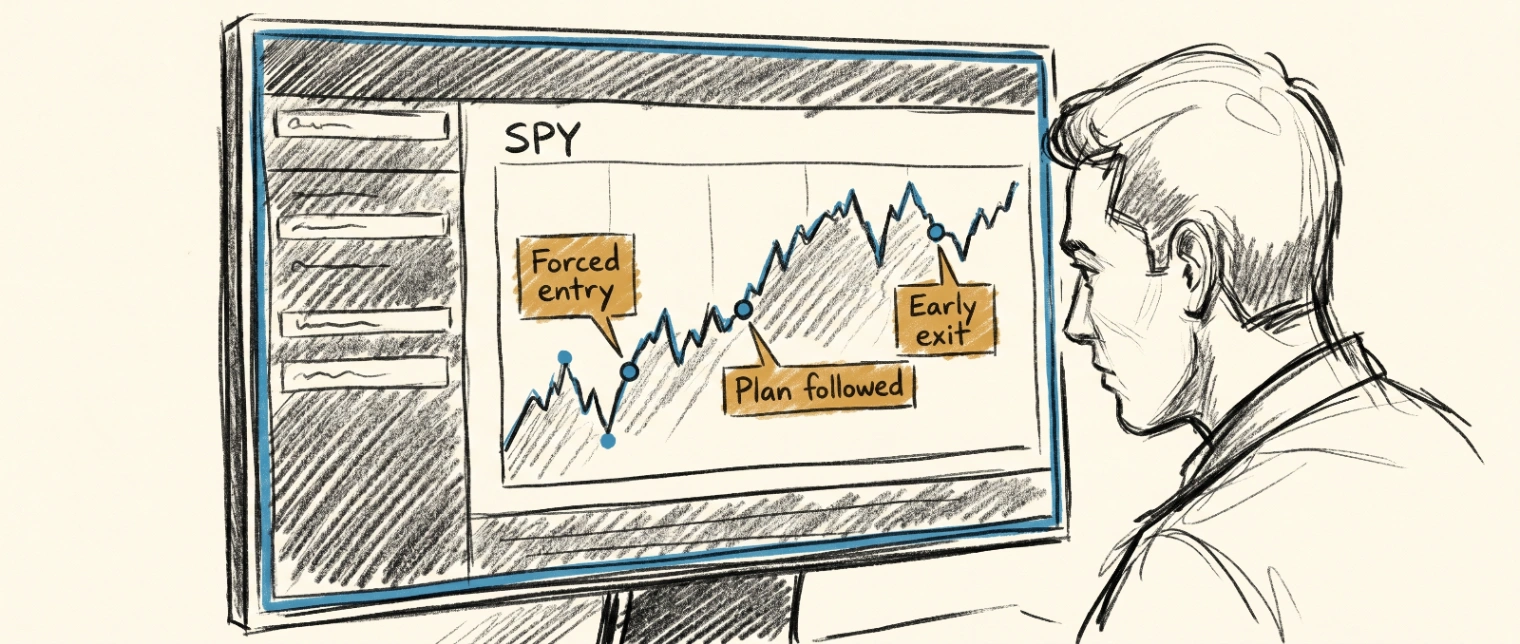
You can tag each paper trade with the setup type, note pre-trade mindset, attach chart screenshots, and review behavioral patterns across sessions. The analytics layer surfaces which conditions produce consistent execution and which ones expose weak points.
For traders using ChartWise during the paper trading phase, the move to live trading is not a leap. It is a continuation of the same process, with real capital added.
If you want to understand how to keep a trading journal that actually changes how you trade, starting with paper trades is one of the most honest environments to do it in.
Paper Trading Builds Your Strategy. Journaling It Builds Your Edge.
Most traders skip the journal and spend months in live trading learning lessons they could have caught in simulation. A paper trading journal compresses that timeline. It gives you honest feedback before the feedback costs you anything.
If you are serious about becoming consistent, start with the journal before you start with live capital.
FAQ
What should I include in a paper trading journal?
A paper trading journal should include the setup criteria, your pre-trade mindset, execution notes on whether you followed the plan, market context, and a post-trade reflection. The most valuable addition is a single behavioral takeaway for your next session, written while the session is still fresh.
How is a paper trading journal different from a live trading journal?
The structure is similar, but the purpose shifts slightly. A paper trading journal focuses heavily on process and behavioral patterns, since there is no financial pressure to distort your reflections. A live trading journal still captures these, but also reveals how emotional pressure affects execution in ways that simulation cannot fully replicate.
How long should I paper trade before going live?
There is no fixed timeline. A paper trading journal gives you better signals than a result does. When decision-making is consistent across different market conditions, when setup criteria are being followed without forcing trades, and when the same weak patterns from your first sessions are no longer appearing, you are closer to ready.
Can I use paper trading to test different markets before committing to one?
Yes. Many traders use paper trading to explore equities, forex, futures, and options before settling into a primary market. A journal helps you track not just which market produced results, but which one suited your decision-making style and emotional bandwidth across different sessions.
Does ChartWise support paper trading journaling?
ChartWise is designed for traders across all stages, including the paper trading phase. You can log practice trades, tag setups, capture mindset notes, attach screenshots, and review behavioral trends over time, all in the same environment you will use when trading with real capital.