What Makes a Good Long-Term Stock? A Checklist Before You Buy
Which shares are good long-term investments? Most investors can recall the stock they purchased because it was the "next big thing." The story was so convincing, the market sentiment appeared to be so strong, and even the charts seemed promising.
However, a few months later, the excitement dies down and the investment is quite disappointing. Actually, finding a good long-term share is not about hype or speed of gains. Rather, it is about finding companies that can grow continuously, survive downturns, and still create value for a long time. Investors who accumulate wealth over several years adhere to methodical procedures before making a purchase.
The Problem: Why Many Investors Struggle With Long-Term Stocks
Many investors begin their investing journey with a lot of excitement but without a well-defined plan. They end up chasing after popular stocks, get influenced by market noises, or depend on short-term momentum without really getting the essence of the business. This leads to a frequently seen issue.
A stock may seem to be an attractive investment option at the present moment simply because its price is going up or it is being talked about a lot.
However, popularity doesn't invariably mean it has lasted time. Stocks that have been popular for some time usually become weak once the market changes or when their growth slows down. If there is no stock buying checklist in place, investors might mistake a burst of emotion as a sign of a good stock. Whether a trade is speculation or smart depends almost entirely on whether one assesses the business behind the stock.
Mindful investing in a company for a long period of time should be less bothered with market noises and more focused on the basics. Simply put, it is about this: can this company keep on growing and making profits in the coming years?
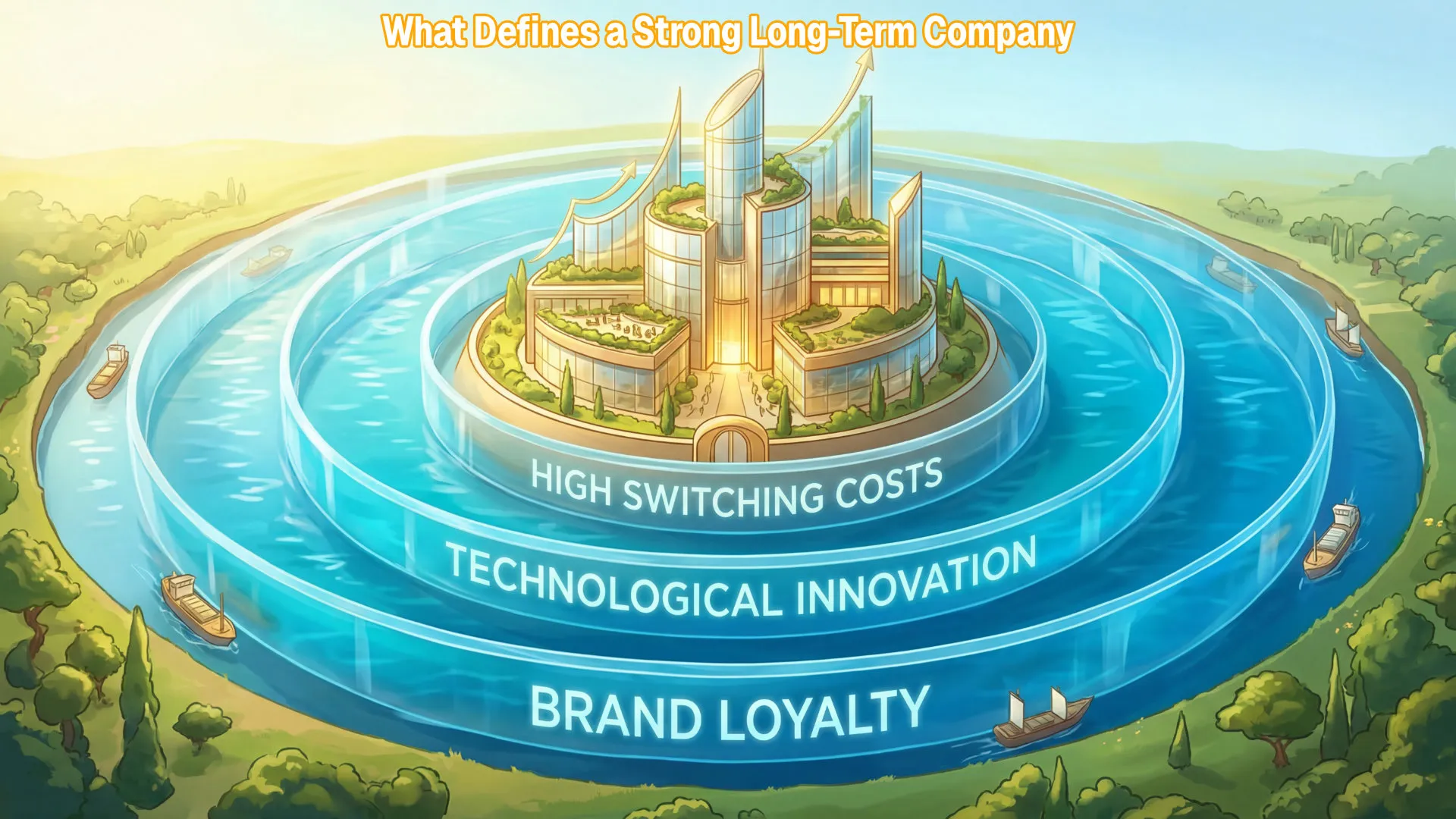
The Insight: What Defines a Strong Long-Term Company
Companies that perform well over long periods usually share several key characteristics. These traits help investors identify businesses that are more likely to survive competition and maintain growth.
One of the most important indicators is sustainable earnings growth. Companies that consistently increase their revenue and profits over time often demonstrate strong demand for their products or services. Growth doesn’t need to be explosive; steady improvement over many years is often a better signal of stability.
Another important factor is the presence of a business moat. A moat represents the competitive advantage that protects a company from rivals. This advantage can come from brand loyalty, technological innovation, network effects, or high switching costs for customers.
When a company has a strong moat, competitors find it difficult to take market share. This allows the company to maintain pricing power and profitability even as the industry evolves.
Financial health also plays a major role. Companies with manageable debt, strong cash flow, and stable profit margins are often better equipped to handle economic uncertainty.
These are the characteristics typically found in quality stocks to hold for the long run. They may not always dominate headlines, but their consistent performance often makes them strong long-term investments.

A Practical Stock Buying Checklist
It would be great to take a moment and assess a company with a basic framework before making an investment decision. Doing this would change investing from a feeling-based decision into a well-thought analysis. To begin with, gain deep foresight into the business model.
Will the company continuously supply products or services that people will need in the future? Usually companies whose businesses are closely connected with long-term trends or indispensable industries can be good investment opportunities. Later, study the company's financial record. Find out companies that have been growing revenue and have been improving their profit margins for the last few years.
Companies who keep producing financial results with which the numbers are in agreement are actually the ones with good management and great operations. Quality of leadership is also one of the major factors. A coherent management team is more likely to make good decisions, plan for innovation, and inform investors properly. Besides, a company's competitive position matters as well. Companies that have a distinct combination of factors like innovative technology, a strong brand, or a large scale of operations are expected to maintain their dominance in the market.
Lastly, consider the stock's valuation very seriously. Even the strongest companies can become a dangerous investment if the stock price has been highly inflated compared to the company's fundamental value. A modest stock purchasing checklist enables investors to be disciplined and prevents them from making rash decisions just because the market is buzzing.
Learning From Real Investment Scenarios
Imagine two investors approaching the market differently.
The first investor tends to buy stocks based on trends. When a company becomes popular in financial media or social platforms, it feels like an opportunity that shouldn’t be missed. Some of these trades might work temporarily, but the portfolio eventually becomes unpredictable.
The second investor approaches the market with patience. Before investing, they review the company’s fundamentals, evaluate its competitive advantage, and consider whether the business has room to grow over the next decade.
Over time, the second approach often leads to a portfolio filled with stronger businesses. The difference between these investors isn’t luck—it’s discipline and structure.
A well-defined long-term investing strategy allows investors to focus on quality instead of chasing short-term excitement.

The Role of Reflection in Long-Term Investing
Market fluctuations and the human element may lead to errors even experienced investors are not immune to. Therefore, it is highly recommended to go back over your past investment decisions.
At that point, when you keep a record of the reasons behind your stock purchases, the factors that influenced you, and the results of the investments, you start to uncover patterns in your thinking. Some decisions may have been made based on thorough research, while others may even show a time when emotions had a bigger impact than reason. In the long run, poker reflection moments result in investors being able to enhance their tactics and cultivate a higher level of discipline in their decision-making process.
Using ChartWise to Strengthen Your Investment Process
It can be tough to keep a manual record of investment decisions. A lot of investors tend to keep separate notes, use the spreadsheet, or just rely on memory to remember why they decided to get into a particular position. After a while, this kind of information gets hard to check or analyze thoroughly. That's when a tool like ChartWise becomes handy.
ChartWise is like a formal trading and investment diary that supports traders and investors in logging their trades, writing down their reasons, and evaluating their trading results over time. Just knowing whether a trade was profitable is not enough with ChartWise - it gives you an opportunity to go back to all details of each decision. Overall, you can identify the patterns in your strategy, look over how different setups worked, and get a deeper insight of your trading psychology.
Reflection at this level can be a major source of value for the investors whose aim is long-term growth. This method changes every trade or investment into a learning experience that guides future decisions.
A Moment to Reflect Before Your Next Investment
Before you buy a stock, it's a good idea to pause for a moment and look at the company carefully. If these things match your investment criteria, then the company could be considered for your portfolio. Otherwise, it might be better to wait for the right opportunity. Very few investors make money by following the crowd and buying in at the highs. Instead, good results come from well-thought-out decisions, sticking to a plan, and always educating yourself.
The Big Picture
It is quite unusual to identify great long-term stocks just by short-term excitement. Those are companies with fundamentally strong businesses, capable of delivering steady growth over the years, and have a handful of enduring competitive advantages.
It can go a long way in investing for the long haul to have a well-planned strategy and a detailed checklist to double-check before making a purchase through which the investor will be able to skip a serious error and build a more powerful portfolio. On top of that, if you keep evaluating and following up with your decisions, you can turn your learning process into something very insightful and well-organized with tools like ChartWise. Finally, at its core, investing is not really about picking the winning stocks, but forming the right set of habits that enable you to make smarter decisions on a continuous basis.