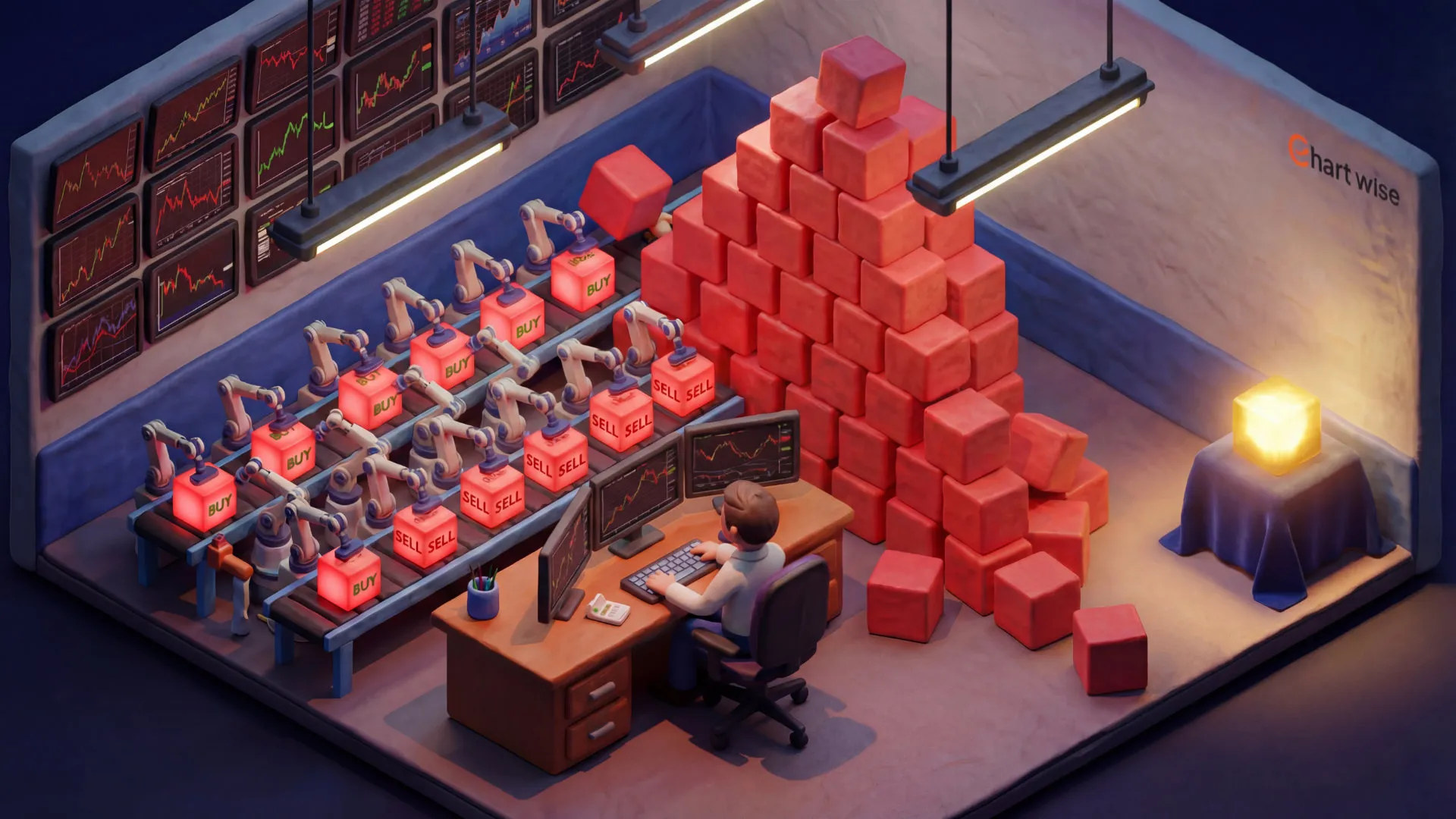
If you’ve ever finished a trading day wondering why you took so many trades, you’re already closer to the truth than most. Overtrading rarely feels reckless in the moment. It feels productive. It feels like “being active.” And that’s exactly why it’s so dangerous.
Most traders don’t lose because they don’t understand charts or indicators. They lose because they don’t notice the patterns forming in their own behavior. Overtrading is one of those patterns that is quiet, repetitive, and expensive. And until you can see it clearly, it keeps draining accounts trade by trade.
That’s where journaling steps in. Not as a chore, but as one of the most practical overtrading solutions a trader can use.
Why Overtrading Feels Invisible While It’s Happening
Overtrading rarely shows up as one obviously bad decision.
Instead, it creeps in through a series of small, seemingly reasonable choices. A minor loss leads to a quick re-entry to “get it back.”
A move you missed turns into chasing price. A slow, boring market tempts you into taking trades just to stay active.
Each of these trades feels defendable on its own. The real damage comes from the sequence they form together.
When you don’t track these decisions, your mind naturally smooths over the losses. You remember the few trades that worked and quietly ignore the cost of being constantly involved.
That’s why many traders look back and say, “I don’t even know where it went wrong.”
In most cases, the answer isn’t hidden in the market. It’s sitting right there in the trades that were never reviewed.
The Real Cost of Overtrading
Yes, overtrading can reduce your profits. But the bigger damage happens in your head. When you take too many trades, your emotions go up and down more often. You get tired faster because you’re making too many decisions. Your discipline becomes weaker, and your execution becomes sloppy.
Over time, this creates bad habits in trading. You stop waiting for clean opportunities. You start clicking trades just to feel like you’re doing something. And after a while, even a good strategy stops working not because the strategy is bad, but because you’re no longer following it the same way every time.
A journal doesn’t stop overtrading by “forcing” you to behave. It stops it by showing you the truth clearly.

How Journals Reveal Overtrading Patterns Quickly
A good trading journal does something simple but powerful: it takes confusing feelings and turns them into clear patterns you can see.
1) Trade Clustering
When you look back at your journal, overtrading becomes obvious. You’ll notice many trades happening close together, especially after a loss or after missing a move. This usually isn’t part of a plan. It’s a reaction. And once you see that pattern written down, it’s hard to ignore.
2) Emotional Overtrading
This is where trading psychology review becomes useful. If you write down your emotions along with each trade, you start seeing connections. For example, frustration might lead to bigger risk. Confidence might lead to careless entries. Boredom might lead to low-quality trades.
Once you know which emotions push you into bad trades, you can fix the real cause instead of blaming the market.
3) Rule Erosion
Most traders don’t break rules suddenly. They bend them slowly. A journal makes this clear because you’ll see the same excuses repeating: “It was almost a perfect setup.” “My stop was too tight.” “I didn’t want to miss it.” Different day, same reason, same result.
When the same excuse keeps coming back, that’s your warning sign.
Why Journaling Builds Discipline (Without Relying on Willpower)
Discipline isn’t about trying harder every day. It’s about removing confusion.
Journaling for discipline works because it replaces memory with facts. When you can clearly see that your worst days come from taking too many trades, you stop arguing with yourself. You don’t need motivation you have proof.
That’s why traders are able to stick to rules like
A fixed number of trades per session
A break after a losing streak
Avoiding certain hours that always lead to mistakes
These rules work because they come from your own data, not someone else’s opinion.
The Problem With Manual Journaling
Here’s the truth: most traders quit journaling.
Not because it’s useless but because it’s tiring. Manual journaling takes time. You have to write everything, take screenshots, calculate numbers, and then try to review it all later. After a few weeks, people stop being consistent. And when consistency disappears, the patterns disappear too.
That’s why many traders journal during drawdowns… and stop once things feel “fine.” Then overtrading returns, and the cycle repeats.
Why Digital Journals Make It Easier
Digital journals remove the hard part. Trades get recorded automatically. Metrics are calculated instantly. Notes, screenshots, and emotions are stored neatly in one place.
When journaling takes seconds instead of hours, people actually stick with it. And that’s what makes it powerful over time.
This is where platforms like ChartWise help. It’s not just a spreadsheet with a nicer look. It’s built to connect your trades, your behavior, your mindset, and your results so overtrading patterns don’t stay hidden.
You don’t only see what you did. You see why you did it.
ChartWise: An Easier Way to Review Transactions and Identify Overtrading
If youve made a serious attempt at journaling, you already know that the main problem is not at all misunderstanding what to do but rather the challenge of staying consistent without making it a second job.
That’s where ChartWise fits in naturally. It’s designed to keep your journaling clean and quick, so you’re not stuck juggling spreadsheets, folders of screenshots, and half-remembered trade reasons.
With ChartWise, you can capture the context that actually matters your setup, your chart, your notes, and the mindset behind the click so your reviews don’t feel like guesswork later.
The best part is how it makes patterns easier to spot.
Overtrading, revenge entries, and boredom trades become quite obvious when everything is nicely organized in one place rather than being scattered across various tools.
Additionally, gradually ChartWise helps to make reviewing a habit that a trader can carry on. You're not merely recording your transactions; rather, you are creating a clearer feedback loop that will enable you to have more control over your trading and make better decisions.

How This Improves Trading Results in Real Life
Once you clearly see your overtrading patterns, your trading starts to change in a simple, natural way.
You don’t take trades just because you feel like doing something. You become more selective. That means fewer trades, but the ones you take are usually cleaner and closer to your plan.
You also stop forcing trades when the market is messy. Instead of chasing random moves in slow or choppy conditions, you learn to step back and wait. That alone saves many traders from unnecessary losses.
And slowly, you start trusting your process again. Not because every trade becomes a winner, but because you know why you entered, why you exited, and whether you followed your rules.
That’s what real confidence looks like in trading. It’s not “I’ll win this trade.” It’s “I’m making decisions I can stand by.” And that kind of clarity is what separates gambling from professional execution.
The Big Picture
Overtrading feels normal while you’re doing it. One extra trade doesn’t look dangerous. But over time, those extra trades are usually what cause the biggest losses.
A journal helps because it shows you the truth. You can see when you’re trading out of boredom, anger, or FOMO. You can see when you’re breaking your own rules. And you can stop repeating the same trading errors.
You don’t need more trades. You need better trades. When you review your journal regularly, you trade less, stay calmer, and follow your plan more often. That’s how results improve and stay consistent.