Introduction
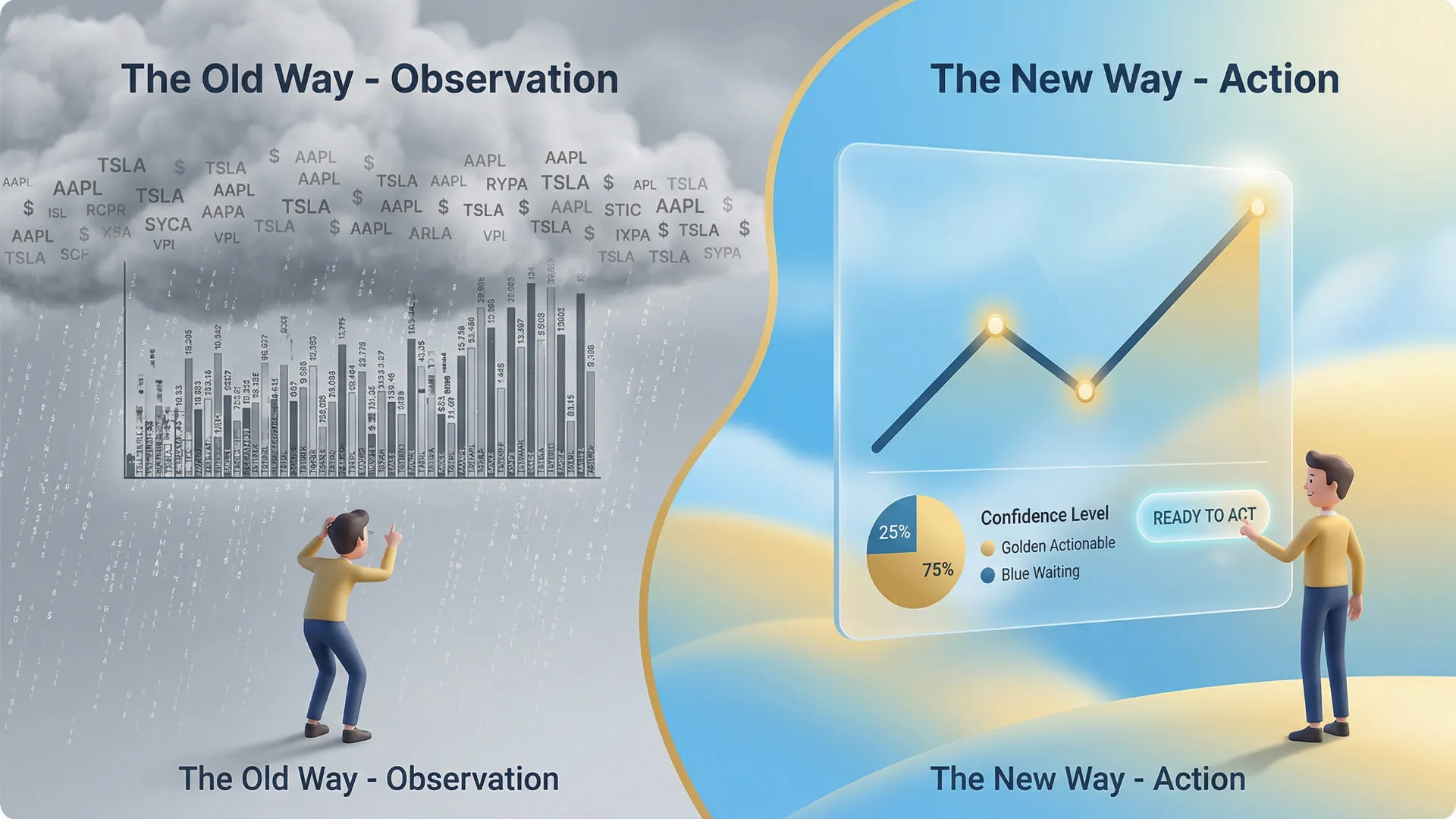
Most traders don’t have a watchlist problem. They have an action problem.
You open charts. You scan multiple stocks. You keep adding more to your trading watchlist.
And yet, when it’s time to take a trade, you hesitate.
Because your watchlist isn’t built for decisions. It’s built for observation.
A trading watchlist should not just show opportunities. It should tell you what to do next.
What Is a Trading Watchlist (And Why Most Traders Get It Wrong)
A trading watchlist is a curated list of stocks or instruments you monitor for potential trades.
But here’s where most traders go wrong:
They treat it like a collection, not a decision system.
The wrong approach
• Adding too many stocks
• No clear selection criteria
• No defined trading setup
• Just “this looks interesting”
The right approach
A trading watchlist is not about what can move.
It’s about what you are ready to trade.
Why Your Trading Watchlist Isn’t Helping You Trade
Too Many Stocks, No Focus
You’re tracking 20–50 stocks.
Your attention is scattered.
No Defined Setup
You’re not following a watchlist strategy for trading.
So everything looks “almost right.”
No Decision Triggers
There’s no clear condition that tells you:
Enter or skip.
Emotional Filtering
You end up choosing trades based on:
• Recent wins
• Fear of missing out
• Random conviction
Not structure.
If your watchlist creates confusion, it’s not a strategy. It’s noise.
The Shift: From Watchlist to Decision List
A strong trading watchlist strategy turns your list into a:
Decision List
Each stock must answer:
• Why is this in my watchlist?
• What setup am I waiting for?
• What confirms the trade?
• What invalidates it?
If a stock has no setup, it does not belong in your watchlist.

How to Build a Trading Watchlist That Drives Action
If you're wondering how to build a trading watchlist that actually works, follow this:
Define Your Trading Strategy First
• Breakout trader
• Pullback trader
• Intraday momentum
Your trading watchlist should reflect your strategy.
You don’t need more stocks. You need better alignment.
Limit Your Watchlist (5–10 Stocks Max)
• 5–10 high-quality setups
• Not 50 random charts
Fewer stocks lead to better trading decisions.
Assign a Setup to Each Stock
• Breakout above resistance
• Retest of support
• Range expansion
A watchlist without setups is just a list, not a system.
Define Entry, Exit, and Invalidation
• Entry point
• Stop loss
• Target
• Invalidation level
Clarity before the trade removes hesitation during the trade.

Categorize Your Watchlist
• Ready to Trade
• Watch for Setup
• No Clear Edge
A categorized trading watchlist reduces decision fatigue.
Review and Update Daily
• Remove invalid setups
• Add new opportunities
• Update levels
Your edge comes from consistent refinement, not random discovery.
Common Watchlist Mistakes to Avoid
• Treating watchlist like a wishlist
• Adding stocks without a plan
• Changing setups mid-trade
• Ignoring invalidation levels
The goal is not to track more. The goal is to decide better.
How ChartWise Fits In
ChartWise helps you:
• Track every trade automatically
• Analyze performance across setups
• Identify behavioral patterns
• Improve decision-making using real data
A trading watchlist gives you opportunities. ChartWise helps you understand which ones are worth taking.
Quick Summary
• A trading watchlist should drive decisions, not observation
• Fewer stocks improve focus and execution
• Every stock must have a defined setup and plan
• A watchlist becomes powerful when it becomes a decision system
• Consistent review builds long-term trading edge
FAQs
What is a trading watchlist?
A trading watchlist is a list of selected stocks or instruments you monitor for potential trades.How many stocks should be in a trading watchlist?
Ideally 5–10 stocks.How to build a trading watchlist for beginners?
Start with one strategy, select a few stocks, define setups, and track performance.
Conclusion
A trading watchlist doesn’t make you a better trader.
Decisions do.
And decisions come from clarity, not clutter.
So the next time you build your trading watchlist, ask:
Am I preparing to observe… or preparing to act?